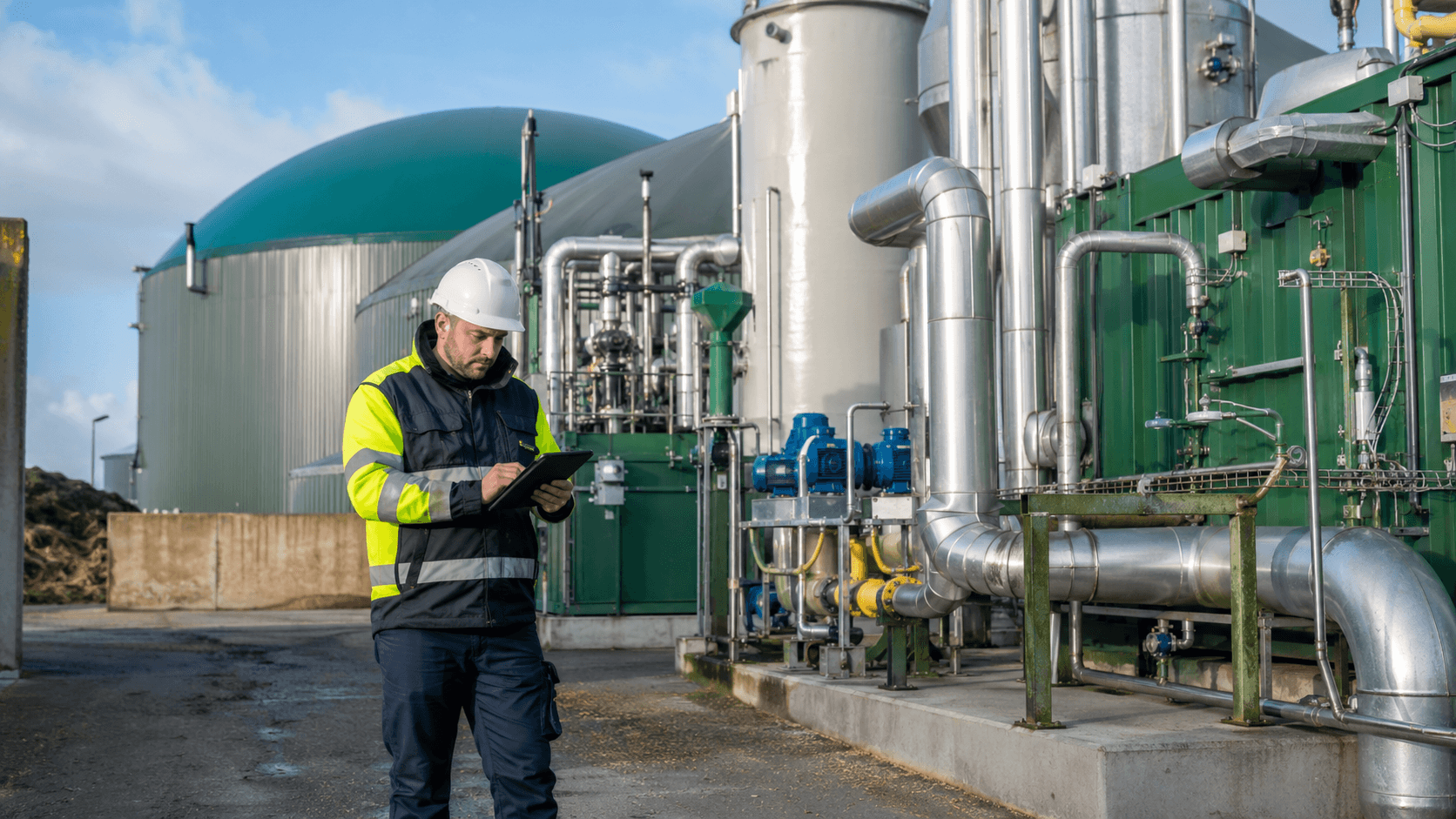
An industrial biogas plant should not be assessed solely as another energy source. Within a company, it is simultaneously part of material management, a process installation and an element of the energy system. The first question is therefore not “what capacity should the unit have?”, but: does the company have a sufficiently stable, predictable and manageable feedstock stream, together with users for the energy it will produce?
This is particularly important in food plants, processing plants and other industrial facilities that generate regular streams of organic by-products, waste or wastewater with a significant organic load. In such cases, a biogas plant can combine management of a material stream with energy production. A project that assumes from the outset that most feedstocks will be purchased on the market and delivered from outside requires a very different assessment.
In practice, three balances need to be established before an investment decision is made: feedstock, energy and process-residue balances. If any of them is based mainly on assumptions rather than data, the economic analysis will be equally uncertain.
When can an industrial biogas plant be a good fit for a company?
The best starting point is a company with its own regularly generated feedstock stream of known characteristics and stable demand for electricity and heat. This does not automatically make the investment profitable, but it removes two of the largest sources of risk: buying fuel and having no outlet for the energy produced.
As an initial screening, it is worth checking five conditions:
- the feedstock is available for most of the year, and its quantity can be confirmed by historical data;
- its composition and properties are sufficiently predictable to estimate biogas production and select the technology;
- the company has a practical way to use the biogas, for example in cogeneration, a process boiler or, where justified, after upgrading it for another form of use;
- there is a heat user outside the heating season as well, if cogeneration is to be the primary option;
- there is a feasible route for digestate management and sufficient space to receive, store and prepare feedstocks.
Only after this screening does detailed technical and economic modelling make sense. The biogas plant should also be assessed together with the other energy sources and loads in the company’s overall energy system, rather than as a stand-alone installation operating alongside the plant.
Feedstock first: a stable in-house stream or market purchases?
This distinction changes virtually the entire risk profile of the investment.
The company has its own feedstock stream
If the material is generated as a predictable result of the plant’s operations, the analysis can start with production data and measurements. Examples include certain streams from agri-food processing, food and beverage production or industrial wastewater treatment plants. The name of the stream alone, however, does not determine whether it is suitable.
Among other things, the following must be established:
- how much material is generated each month and during a typical production day;
- how its composition changes with the product, recipe, season and production-line load;
- whether there are maintenance shutdowns or periods of low production;
- whether cleaning agents, disinfectants, salts, sulphur compounds or other substances that may affect the biological process enter the stream;
- whether the material requires size reduction, separation, homogenisation, hygienisation or other preparation;
- what its legal status is and what obligations arise from its origin.
An in-house stream reduces price and logistics risk but does not eliminate technology risk. A change in product recipe, the start-up of a new line or a reduction in production can materially change the quantity and quality of the feedstock after several years. A biogas plant should therefore not be sized solely to the plant’s best production year.
The project requires feedstock purchasing and transport
If most of the feedstock is to come from outside, the project is no longer just an energy investment. It also becomes a procurement and logistics operation.
The model should then include at least:
- the number of independent suppliers and the share supplied by the largest one;
- the minimum and maximum quantities guaranteed by contracts;
- the material quality specification and rules for rejecting deliveries;
- seasonal availability;
- the purchase price or other settlement terms;
- transport cost and distance;
- storage requirements;
- the risk of competition for the same feedstock stream;
- the consequences of a supply interruption lasting a week, a month or longer;
- price-adjustment rules in long-term contracts.
Annual availability of 20,000 or 30,000 tonnes does not in itself guarantee fuel supply for the installation. What matters is how much of that volume is actually contracted, in which months the material is available, and whether the parameters of individual batches remain within the operating range of the selected technology.
From an auditor’s perspective, a project based on an in-house stream and one based on purchased feedstocks should have two different risk models. In the second case, loss of the main supplier or an increase in logistics costs is just as important as the efficiency of the cogeneration unit.
What data should a company collect before assessing a biogas plant?
There is no need to start with a complete process design. What is needed is a reliable set of input data. The earlier it is collected, the sooner options that look attractive only in a sales presentation can be ruled out.
| Area | Data to collect | Why it is needed |
|---|---|---|
| Feedstock quantity | mass or volume by month, week and, where relevant, day; at least one representative seasonal cycle | to determine realistic availability and variability of the feed supply |
| Origin and status | source of generation, production process, classification as a product, by-product, waste or material subject to specific requirements | to establish legal, transport and process requirements |
| Material parameters | dry matter, organic fraction, pH, nitrogen and sulphur content, contaminants; for liquids, also parameters appropriate to the specific stream, e.g. organic load | preliminary assessment of technology, process loading and inhibitor risk |
| Biogas potential | results of BMP tests or other reliable tests on representative samples, including methane content | to build the biogas balance from data rather than catalogue values |
| Quality variability | results from several production periods and different batches | to assess the installation’s operating range and the need for blending or buffering |
| Logistics | delivery form, density, unloading method, transport route, storage location and required number of buffer-storage days | to size receiving infrastructure and estimate operating costs |
| Electricity | at least hourly load profiles, preferably 15-minute data, distinguishing between production and shutdown periods | to determine the potential self-consumption of electricity from cogeneration |
| Heat | annual demand profile, temperature and heat-transfer medium, process loads, seasonality and summer demand | to determine the amount of useful heat rather than merely the heat that could be produced |
| Digestate | expected quantity, composition, storage capacity, possible recipient or further management route | to verify that the project has a closed material balance |
| Location | available area, roads, neighbouring land uses, utility connections and the feasibility of heavy-vehicle traffic | preliminary site and permitting screening |
In practice, the scope of laboratory testing should be tailored to the specific material. A homogeneous liquid stream from a food plant is assessed differently from a mixture of several externally supplied solid feedstocks.
Feedstock variability – why is an annual average not enough?
Anaerobic digestion is a biological process. For this reason, two batches of material with the same mass may not be equivalent from the plant’s perspective.
The following may vary, among other factors:
- dry matter and organic fraction content;
- the share of readily degradable fats, proteins and carbohydrates;
- biogas production potential;
- the methane content of the biogas;
- nitrogen, sulphur, salt and other components that affect the process;
- the presence of sand, plastics, metals or other contaminants;
- residues of process chemicals and cleaning agents.
If a project is calculated using a single “average” gas-yield value, annual production can easily be overestimated. A better approach is to build a range of scenarios: a base case and variants reflecting lower quality, reduced feedstock volume and changes in the feed recipe.
For purchased streams, it is also worth defining an acceptance specification. The price per tonne matters little if the material contains too much water or contamination, or if its properties vary so widely that frequent process adjustments are required.
How should biogas be used: cogeneration, heat or upgrading?
Biogas does not have to be used in only one way. For an industrial plant, it is usually worth comparing several options.
1. Cogeneration – electricity and heat
A CHP unit can produce electricity and heat at the same time. This is a natural option for a plant with year-round demand for both forms of energy. The key word, however, is “useful”: heat for which there is no demand should not be valued in the economic analysis in the same way as heat that actually displaces a boiler or another heat source.
Before selecting the unit capacity, biogas production should therefore be compared with the electricity load profile and the heat-demand profile. CHP sizing should result from the combined balance of available fuel, electricity demand and the ability to use heat, not from annual biogas production alone.
2. Direct heat production
If the company has high and stable demand for heat or steam but lower electricity demand, it is also worth assessing a simpler option in which biogas is used directly for thermal purposes. Cogeneration should not be forced solely because it produces two forms of energy.
3. Biogas upgrading
Removing undesirable components from biogas is also required before it can be used in some energy equipment, but biogas cleaning for engine operation should not be confused with full upgrading to biomethane. Biomethane production is a separate technology option involving additional equipment, quality requirements and a defined route for product offtake.
For an industrial plant, this should be a comparison case rather than an automatic assumption. Its suitability depends on scale, stability of gas production, available offtake routes and infrastructure.
Cogeneration: heat utilisation often determines the result
In a biogas-plant assessment, it is easy to focus on electricity because the power-consumption profile is usually readily available. With cogeneration, however, the heat-demand profile is equally important, especially in summer.
The EU Energy Efficiency Directive defines useful heat as heat produced in a cogeneration process to satisfy an economically justifiable demand. This is also a sound principle for investment appraisal: heat should not be counted as a benefit merely because the unit is technically capable of producing it.
A simple example
For illustration only, assume that the CHP offer being considered specifies:
- 500 kW of electrical capacity;
- 550 kW of available thermal capacity;
- 8,000 operating hours per year.
Annual production would then be approximately 4,000 MWh of electricity and 4,400 MWh of heat.
If the company can actually use only 30% of the heat, the useful volume is approximately 1,320 MWh/year. At 80% utilisation, it would be 3,520 MWh/year. The difference is 2,200 MWh of heat per year even though the unit itself and its nominal output have not changed.
This example is not intended to size a specific unit. It merely shows why two plants with the same biogas production can achieve completely different economic results.
The heat parameters must also be checked. If the process requires steam or a high temperature, it is not enough to say that “the plant uses heat”. The analysis should determine which circuit of the CHP unit can supply it, at what temperature, and whether an additional waste-heat boiler, heat exchanger or other system-integration equipment is required.
Digestate, storage and process requirements may determine feasibility
Biogas is only one output of the process. After digestion, a substantial amount of material remains and must be managed. The assessment should therefore cover from the outset:
- the expected quantity of digestate;
- its properties and variability;
- the required storage time and capacity;
- the possibility of separating fractions;
- recipients and transport distance;
- legal status and permitted use or management route.
It should not be assumed automatically that “the digestate will be fertiliser” and the issue is therefore resolved. The appropriate route depends on the origin of the feedstocks, the characteristics of the digestate and the applicable regulations.
For feedstock preparation, the same principle applies. For certain animal by-products, EU rules impose specific requirements on biogas plants. Annex V to Regulation (EU) No 142/2011 sets standard minimum parameters for specified materials sent to a plant equipped with a pasteurisation/hygienisation unit: a maximum particle size of 12 mm, a temperature of 70°C and 60 minutes without interruption. At the same time, the rules provide for derogations and alternative routes depending, among other things, on the category and prior processing of the material. This is a good example of a requirement that can materially change the process layout, heat demand and CAPEX.
If the material used has waste status, the assessment must establish the current requirements in Poland for its collection, treatment, storage and record-keeping, as well as the administrative decisions required for the specific installation. The scope of obligations depends on the type and status of the material, the way the process is operated and any specific regulations, so requirements from another biogas plant should not be transferred automatically.
“Industrial biogas plant” does not always mean the same permitting route
The term “industrial biogas plant” is useful from a business perspective, but it is not sufficient to determine the legal classification of an investment. Relevant factors include the type of feedstock, how it is sourced, whether it has waste status, the scale of the installation and how the gas and energy are used.
Poland has specific legislation designed to facilitate the preparation and implementation of investments in agricultural biogas plants. However, it should not be assumed that every installation built next to a processing plant automatically qualifies for this route. Eligibility must be checked against the current Polish Act and the actual feedstocks used.
Irrespective of this, an investment in Poland requires early environmental and site screening. A new consolidated text of the Polish Act on environmental information and environmental impact assessment was published in 2026, and the regulation on projects likely to have significant effects on the environment was amended with the change entering into force on 13 June 2026. At the concept stage, it is therefore better to establish the permitting route for the specific project than to copy assumptions from another biogas plant.
In-house feedstock versus purchased feedstock – two different project models
| Element | Own stable stream | Purchased and delivered feedstock |
|---|---|---|
| Availability | depends mainly on the company’s own production | depends on the market and supplier contracts |
| Price risk | usually lower, although the cost of the existing alternative management route should be taken into account | price, indexation and delivery terms are among the main risks |
| Quality | a measurement history can be built for the company’s own process | an acceptance specification and batch control are required |
| Logistics | usually shorter and easier to predict | transport costs, heavy-vehicle traffic and storage can be significant components of OPEX |
| Variability | results from changes in production, recipes and seasonality | additional differences between suppliers must also be considered |
| Strategic risk | change in the plant’s production profile | loss of a supplier or competition for the feedstock |
| Key test | whether the stream will remain available throughout the installation’s operating life | whether the required quantity, quality and price can be secured contractually |
This difference should also be reflected in sensitivity analysis. For in-house feedstock, scenarios may include a fall in the plant’s production or a recipe change. For purchased feedstock, additional scenarios should include higher transport costs, a change in raw-material price, loss of part of the supply and the need to replace it with more expensive material.
How should a pre-investment assessment be carried out step by step?
The practical sequence of work matters more than a sophisticated financial model built on unverified data.
- Build a stream balance covering at least one full seasonal cycle. Collect monthly data and, for highly variable streams, weekly or daily data as well.
- Establish the status and origin of each feedstock. Do not combine in one item materials that have different characteristics or are subject to different legal requirements.
- Perform representative testing. A single sample may not describe a full year of operation. For key feedstocks, it is worth understanding both variability and biogas potential.
- Build the biogas balance for several scenarios. A basic mistake is to calculate a single case using the maximum gas yield.
- Overlay the gas-production profile on the energy-demand profiles. Compare CHP, direct thermal use and, where justified, gas upgrading.
- Count only heat that has a real user. Assess summer months separately and verify the parameters required by the process.
- Finalise digestate management and logistics. Account for storage, transport, recipients and legal requirements.
- Carry out site and permitting screening. Only after that is it worth developing a technical option that requires substantial design expenditure.
- Perform a sensitivity analysis. Check what happens with less feedstock, lower gas yield, lower heat utilisation, changes in energy prices and higher logistics costs.
A well-prepared study should not set out to confirm a predetermined thesis that “the biogas plant has to be profitable”. Its purpose is to identify the conditions under which the project is technically and economically justified, and the point at which it ceases to be robust to changes in assumptions.
What should the economic model include?
A financial model should only be built once the technical balances have been closed. It should separate items that are often combined into a single “biogas plant cost”.
On the CAPEX side, the model should include not only digesters and the CHP unit, but also feedstock reception and storage, feed preparation, the gas installation and biogas cleaning, connections, heat integration, digestate storage, automation, safety systems and any components required because of the type of raw material.
On the operating-cost side, relevant items may include feedstock purchase and transport, energy for auxiliary loads, maintenance, laboratory testing, operation, consumables and further management of process residues.
Benefits, in turn, should be calculated separately as:
- electricity actually consumed on site or sold;
- heat actually used to displace another source;
- any avoided cost of the existing management route for the company’s own stream, provided that the cost is real and documented;
- other revenues only where there is a realistic route to earning them.
A grant or support scheme can improve the result, but it should not conceal a weak technical balance. The analysis should use only the current rules of the relevant programme or mechanism and clearly separate the “without support” case from the “with support” case.
When would I not start with a cost estimate for the biogas plant itself?
There are situations in which a detailed technology quotation is premature. I would first organise and verify the data if:
- the company does not know the monthly quantity of its own feedstocks;
- feedstock availability is based on an oral declaration from a single external supplier;
- there are no tests representative of the actual stream;
- heat has been entered as the main benefit, but no summer users have been identified;
- it is not known how the digestate will be managed;
- the cost of feedstock transport and storage has not been calculated;
- the legal status of the materials has not been checked;
- CHP capacity was selected before balancing biogas production against the energy-demand profile.
In such a case, a short screening of the data and options is a better first step. It may show that the right solution is a smaller installation, a different way of using the gas or abandoning the project altogether.
What about an existing biogas plant? Technology audit and modernisation
The assessment does not apply only to new investments. In an operating installation, a biogas plant technology audit can answer a different question: where is the energy potential being lost between feedstock reception and useful energy output?
The scope of such diagnostics may include, among other things:
- a mass and quality balance of the feedstocks supplied;
- comparison of gas-potential test results with actual production;
- variability in biogas composition and cleaning requirements;
- energy use for mixing, pumping, heating and other auxiliary loads;
- operating hours, downtime and load of CHP units;
- heat utilisation in successive months;
- the amount of gas sent to the flare or left unused for other reasons;
- options for changing the feed recipe and process operating parameters;
- logistics and digestate management.
Only this type of balance provides a sound basis for planning biogas plant modernisation or optimising the digestion process. Simply replacing the unit with a larger one will not improve the result if the limiting factor is unstable feedstock, insufficient gas production or lack of heat demand.
The key conclusion: design the biogas plant together with the industrial site
An industrial biogas plant has the greatest potential when it simultaneously solves a real material-management and energy problem for the company. Stable in-house feedstock, year-round energy demand and a well-designed digestate-management route form a much stronger foundation than merely having space for a digester and generating unit.
If the project requires raw material to be purchased on the market, the investment may still be justified, but its analysis must cover the supply chain just as thoroughly as the process technology. In both cases, the correct sequence is the same: first data on feedstocks and energy demand, then technology options, and finally the economic model.
If a company has organic by-product streams and wants to determine whether they can become part of its energy system, the first step should be to compile a material balance and energy profiles. These data can then support a pre-investment study that compares options instead of assuming one technology from the outset.
FAQ
Does an industrial biogas plant make sense without in-house feedstock?
It can, but the project then carries additional procurement and logistics risk. The assessment must consider not only the raw-material price, but also guaranteed quantity, quality, seasonality, number of suppliers, transport and the terms of long-term contracts.
Is cogeneration always the best way to use biogas?
No. Cogeneration is particularly attractive when the company can use both electricity and heat. With a different demand profile, a heat-only option or, following additional analysis, gas upgrading may be preferable.
How much historical feedstock data should be collected?
At least enough to cover the full seasonality of the process. In many plants this means a minimum of 12 months of data; where production varies significantly, a longer history is worth analysing.
Can digestate from a biogas plant automatically be treated as fertiliser?
This should not be assumed. The management route depends on the type of feedstocks used, the characteristics of the digestate and the rules applicable to the specific case. The route should be established at the project-feasibility stage.
What does a technology audit of an existing biogas plant provide?
It brings together feedstock flows, actual gas production, the installation’s auxiliary energy use, and energy production and utilisation. This makes it possible to identify whether the constraint lies in the digestion process, feedstock quality, auxiliary equipment, CHP, heat utilisation or operating practices.
Sources and legal basis
- Polish Renewable Energy Sources Act – consolidated text published in 2026;
- Polish Act facilitating the preparation and implementation of investments in agricultural biogas plants – consolidated text from 2026;
- Regulation (EC) No 1069/2009 on animal by-products
- Regulation (EU) No 142/2011 – requirements including those for biogas plants processing specified animal by-products
- Polish Waste Act – Journal of Laws 2023, item 1587, as amended;
- Polish Act on environmental information and environmental impact assessment – consolidated text published in 2026
- Polish Regulation of 26 May 2026 amending the list of projects likely to have significant effects on the environment
- Directive (EU) 2023/1791 on energy efficiency – consolidated text of 5 August 2026
- IEA Bioenergy Task 37: Implementation of anaerobic digestion facilities in the food and beverage industry, 2025
- JRC/EU-BRITE: Waste Treatment BREF