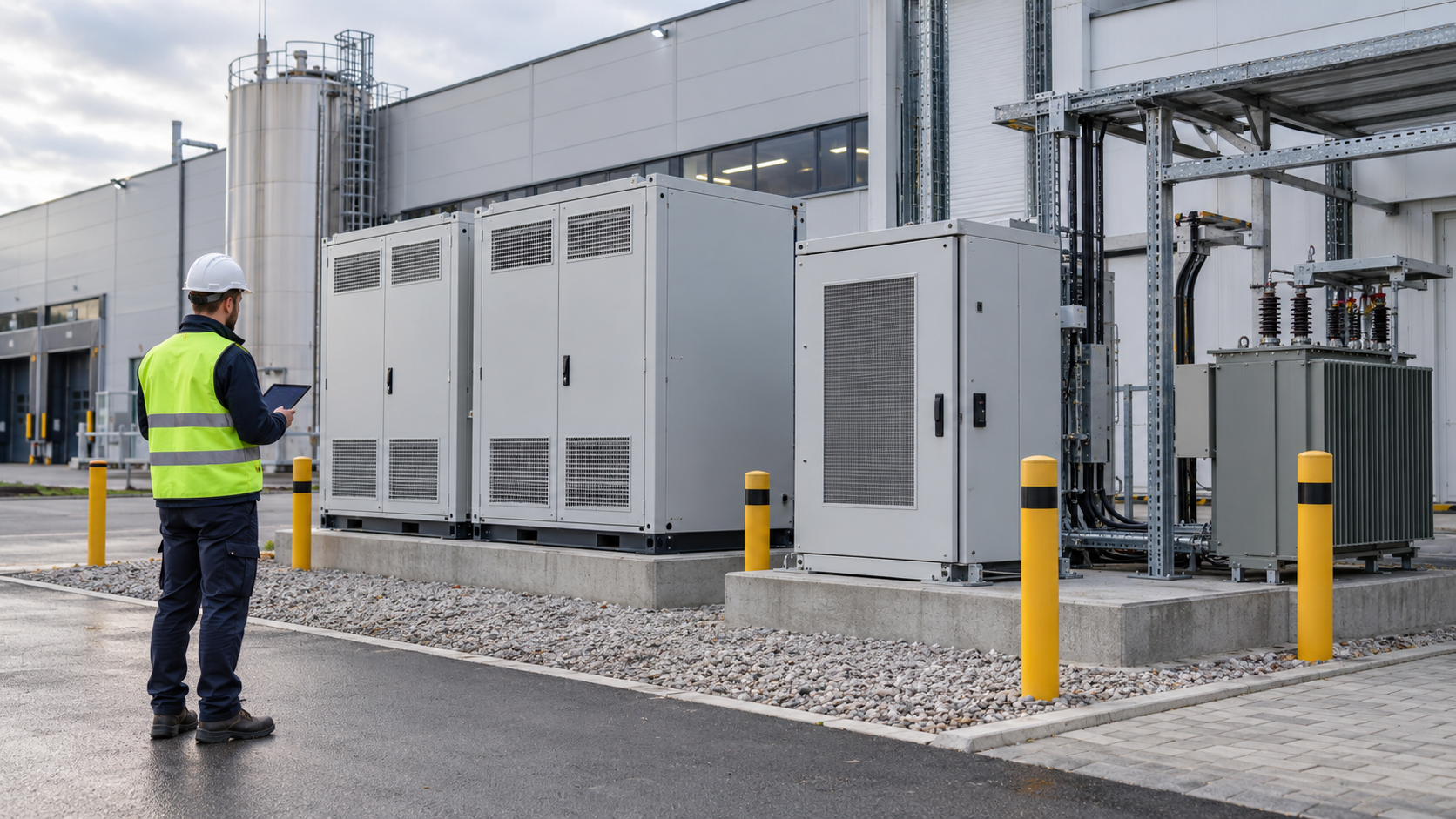
A battery energy storage system for peak shaving is sized around the pattern of demand peaks, not annual electricity consumption. System power (kW) must be sufficient to cut the highest peak, while capacity (kWh) must sustain that reduction for as long as needed. The result also depends on whether the battery has recharged before the next peak.
How do you determine the power and capacity of a peak-shaving battery?
First, establish the maximum grid import the facility intends to maintain. Then calculate, for each interval in the load profile, how much power the battery must supply. The result is the starting point for sizing inverter/PCS power and usable battery energy.
- Required AC discharge power: the largest positive difference between the facility’s demand without BESS and the chosen limit, expressed in kW.
- Required AC energy delivered: the sum of those differences multiplied by the duration of each consecutive interval, expressed in kWh. In a 15-minute profile, each interval lasts 0.25 h.
- Nominal capacity: the energy requirement adjusted for discharge losses, the restricted state-of-charge (SoC) window, expected capacity fade and a justified reserve.
This calculation applies to a particular event, assuming the battery can discharge at the required power. Final sizing cannot be based on a single peak: the entire chronological operating profile and the charging opportunities between events must be analysed. Power, energy and dispatch constraints are also covered in the System Advisor Model (SAM) – Battery Dispatch documentation.
What data do you need before starting the calculations?
The most useful input is a representative import profile measured at the grid connection point, ideally covering a full year at 15-minute intervals. If production varies considerably, data from several operating periods will help. Where loads change very rapidly, quarter-hourly data alone may be insufficient to assess instantaneous stresses on equipment and protective devices.
| Input data | What needs to be established? |
|---|---|
| Chronological electricity import/consumption profile and, where applicable, on-site generation | Peak magnitude, duration, sequence and frequency, plus available charging windows. |
| Distribution agreement, tariff group, invoices and metering rules | Contracted capacity, how exceedance charges are calculated, billing periods and the actual financial value of reducing demand. |
| Target grid-import limit and production schedule | How many kW of import must be reduced, and when; whether shifting equipment operation could replace battery storage. |
| Parameters of the BESS under consideration | AC PCS rating, charging power, available SoC range, separate charging and discharging efficiencies, temperature limits and degradation. |
| Installation diagram, on-site energy sources and planned investments | BESS metering and connection points, transformer and protection constraints, and the future load profile. |
If you are still comparing potential battery applications for your company, see our article on industrial energy storage – applications and sizing. Here we focus on one task: keeping grid import below a set limit during demand peaks.
Step 1. Set the limit the BESS must maintain
Suppose the facility’s maximum grid import in the period analysed is 620 kW, while the control objective is not to exceed 500 kW. The quarter-hour with the highest average power requires a 120 kW reduction. However, that does not automatically mean that any battery system rated at 120 kW will be sufficient.
Check the AC output power available under actual operating conditions, inverter and cell limits, temperature, state of charge, any restrictions associated with the chosen capacity, and losses between the connection point and the meter. If the limit applies at the grid connection point, the control system should use a measurement at that same point or a properly reconciled energy balance.
The 500 kW limit in this example is a technical assumption, not a universally applicable contracted-capacity value. Before assessing financial benefits, examine the terms of the applicable tariff and agreement separately.
Step 2. Calculate energy over the entire peak – a 15-minute example
Consider a hypothetical one-hour event. The facility uses no additional energy source during this period, and each stated demand value is the average grid-import power for the corresponding quarter-hour before BESS dispatch. Objective: keep grid import at or below 500 kW.
| Interval | Import without BESS | Required reduction | AC energy from BESS |
|---|---|---|---|
| 10:00–10:15 | 600 kW | 100 kW | 25 kWh |
| 10:15–10:30 | 620 kW | 120 kW | 30 kWh |
| 10:30–10:45 | 610 kW | 110 kW | 27,5 kWh |
| 10:45–11:00 | 550 kW | 50 kW | 12,5 kWh |
| Total | – | Maximum 120 kW | 95 kWh |
Calculation result for this event
Power: at least 120 kW of available AC discharge power at the required metering/balancing point. Energy: 25 + 30 + 27.5 + 12.5 = 95 kWh delivered to the installation over the hour. It would be incorrect to multiply the maximum reduction of 120 kW by the entire hour and assume 120 kWh without examining the shape of the peak.
The 95 kWh result is not yet the device’s nominal capacity. It excludes losses, the SoC operating window, battery ageing and the next peak.
Step 3. Convert 95 kWh into nominal capacity and check power limits
For a preliminary calculation, assume the following solely for this example:
- discharge efficiency from the battery to the AC side: 95%;
- usable SoC window: 80% of available capacity, for example from 10% to 90%;
- capacity remaining at the end of the assumed operating life: 80% of initial capacity.
The energy that must be drawn from the battery is 95 kWh / 0.95 = 100 kWh. To make that amount available even after the assumed degradation, the minimum nominal capacity in this simplified model is:
100 kWh / (0.80 × 0.80) = 156.25 kWh.
This is a model calculation, not a recommendation to purchase a 156 kWh BESS. It assumes the full SoC window is available at the start of the event and efficiency is constant. The engineering design must also account for the specific manufacturer’s data, auxiliary power consumption, temperature, availability, a dispatch reserve and module sizing.
It is also necessary to check whether the battery can deliver the required power. During the peak quarter-hour, 120 kW AC at 95% discharge efficiency requires approximately 126.3 kW on the DC side. Meeting the 156.25 kWh capacity requirement alone does not guarantee this power: current limits, permissible discharge rate (C-rate), the PCS or derating at low SoC may constrain output. Consult the documentation for the system under consideration; the modelling approach is described in SAM – Battery Cell and System.
Step 4. Check whether the battery can recharge before the next peak
Returning to the example, the battery must replenish 100 kWh of stored energy after the one-hour peak-shaving event. At an assumed charging efficiency of 95%, this requires approximately 105.3 kWh of energy drawn on the AC side. Together with the assumed 95% discharge efficiency, this gives a modelled round-trip efficiency of 90.25%; the same losses must not be applied a second time in this calculation.
If the facility imports 460 kW after the peak and the limit remains 500 kW, at most 40 kW is available for grid charging. Replenishing 100 kWh in the battery then takes, in this simplified example, 105.3 / 40 = approximately 2.63 hours, provided demand stays at 460 kW and the system can charge at that power. If the next peak comes after two hours, a full SoC recovery will not be possible without changing the operating strategy.
That is why two identical peaks in one day can call for a different capacity than a single isolated peak. Their sequence, the time between them, opportunities to charge from PV or the grid, and maximum grid-import constraints all matter.
Step 5. Run a chronological simulation instead of summing annual exceedances
For each candidate combination of power and capacity, work through successive intervals of the profile from start to finish, carrying the state of charge forward. At a minimum, the simulation should apply the following rules:
- For each interval, calculate import without BESS and the difference from the target power limit.
- Discharge storage only within the available PCS power, SoC, energy and permissible response-time limits.
- Charge storage when headroom below the limit, the operating schedule and the energy source allow it; include charging efficiency.
- Carry SoC into the next interval and record every portion of a demand peak that could not be shaved.
- Repeat the calculations for beginning- and end-of-life capacity, periods of reduced availability and alternative production scenarios.
The outputs should include not just the selected kW and kWh, but also the new maximum grid import, the number and size of any remaining exceedances, time spent at the limit, charging energy, losses, battery energy throughput and expected cycles. SAM documentation describes peak-shaving algorithms that account for both the profile and state of charge at successive time steps. See the official BESS dispatch documentation.
Three scenarios worth comparing
| Scenario | What does it test? | Example warning sign |
|---|---|---|
| Typical production | Daily peaks, scheduled breaks and realistic charging windows. | The battery shaves the first peak, but the second arrives at low SoC. |
| Increased production or a new line | Higher base load, longer peaks and less headroom for charging. | There is not enough time to restore energy, even with sufficient PCS power. |
| Limited availability | Hot weather, low temperature, ageing, servicing or an unavailable module. | Power or capacity available at the peak is lower than the nameplate rating. |
Degradation depends, among other things, on operating conditions, temperature, SoC and cycling; a single percentage should not be assumed for every technology and use pattern. The SAM battery-life model documentation may help.
Will a peak-shaving battery be financially worthwhile?
Savings do not follow automatically from lowering maximum demand by a certain number of kW. The actual electricity bill must be recalculated using the simulated import profile and the contract terms. Under Polish electricity billing rules, the contracted-capacity charge, the charge for exceeding contracted capacity and the capacity-market charge are separate components. Shaving the highest quarter-hour does not necessarily reduce all of them.
| Option | What should be compared? | Key limitation |
|---|---|---|
| Control and rescheduling of electrical loads | Potential peak reduction without a battery, automation costs and production impact. | Not every process can be stopped or rescheduled without technological consequences. |
| Changing contracted capacity or distribution terms | Charges before and after the change, and exceedance risk over the entire representative period. | Reducing contracted capacity requires an appropriate agreement with the distribution operator, not merely a temporary demand reduction. |
| BESS battery storage with EMS | Avoided charges, charging energy and loss costs, investment, maintenance, degradation, replacements and financing. | The value depends on how often peaks occur and whether the required power and energy are available at the right time. |
Checking bills, tariffs and the import profile is common to all three options. We discuss billing in more detail in our guide to electricity cost optimisation. When interpreting Polish tariff charges, always use the current tariff of the relevant distribution operator. Poland’s Energy Regulatory Office (URE) announced the approval of distribution tariffs for 2026; the applicable DSO tariff sets out the full billing rules.
The financial assessment should compare at least a baseline, a load-control option and several BESS configurations. It should estimate net economic value over a defined period, including sensitivity to load-profile changes, tariffs, costs and availability. Without these inputs, it is impossible to state a credible payback period.
Most common sizing mistakes
- Sizing solely by peak power: ignores peak duration and sequence, and therefore energy demand and charging needs.
- Confusing nominal and usable capacity: overlooks SoC, efficiency and capacity fade over time.
- Assuming full power under all conditions: disregards PCS, cell, temperature, connection and protection limits.
- Allocating the same resource to multiple purposes at once: energy reserved for backup power or used for energy arbitrage is not automatically available for peak shaving.
- Calculating savings without the tariff and contract: a lower peak does not translate into a proportional reduction of the entire bill.
What to prepare for a BESS options assessment
If you are considering battery storage to limit peak demand at your facility, prepare an installation description, any available 15-minute load profile, invoices and tariff details, the target import limit, and information about planned production changes. If you already have a battery proposal, include PCS specifications, capacity and stated dispatch limits. You do not need a complete set of measurements for the initial discussion.
These materials will help identify the missing data needed to compare options and whether load control should be assessed first. Send the information to Energy Trend to agree on the next steps.
Frequently asked questions
Does a peak-shaving battery require solar PV?
No. A BESS can charge from the grid if technical conditions and its operating strategy permit. PV may provide an additional charging opportunity, but having solar panels does not guarantee sufficient energy before a peak.
Does shaving 120 kW off a peak mean contracted capacity can immediately be reduced by 120 kW?
No. You must demonstrate that the appropriate limit can be maintained during other demand peaks and billing periods as well, and check the operator’s requirements for amending the contract.
Is a 15-minute load profile enough for engineering design?
It is a sound basis for many billing analyses, but a design also needs data on the installation, protection devices, rapidly varying loads, system limits and connection requirements.
Technical and tariff sources
- National Laboratory of the Rockies – SAM: Battery Dispatch (Behind the Meter) – dispatch control, SoC, charging and discharging limits.
- National Laboratory of the Rockies – SAM: Battery Storage (Behind the Meter) – power, capacity, efficiency and losses.
- National Laboratory of the Rockies – SAM: Battery Life – degradation, service life and replacements.
- U.S. Department of Energy – Federal Demand Flexibility – alternatives such as load reduction and shifting; U.S. tariff rules are not assumed to apply in Poland.
- Poland’s Energy Regulatory Office (URE) – approval of distribution tariffs for 2026 – Polish billing context; actual rates must be checked against the tariff of the relevant DSO.