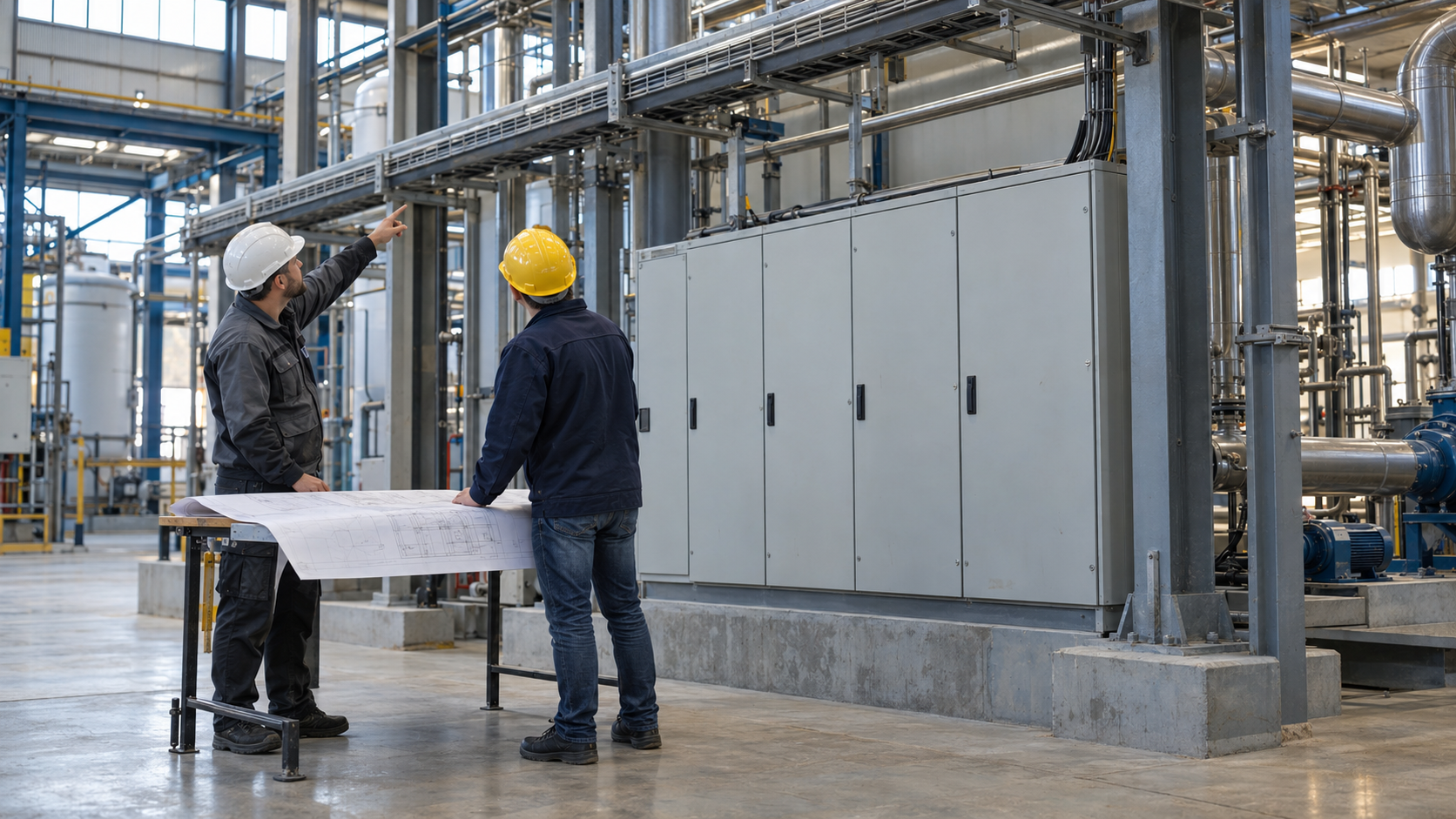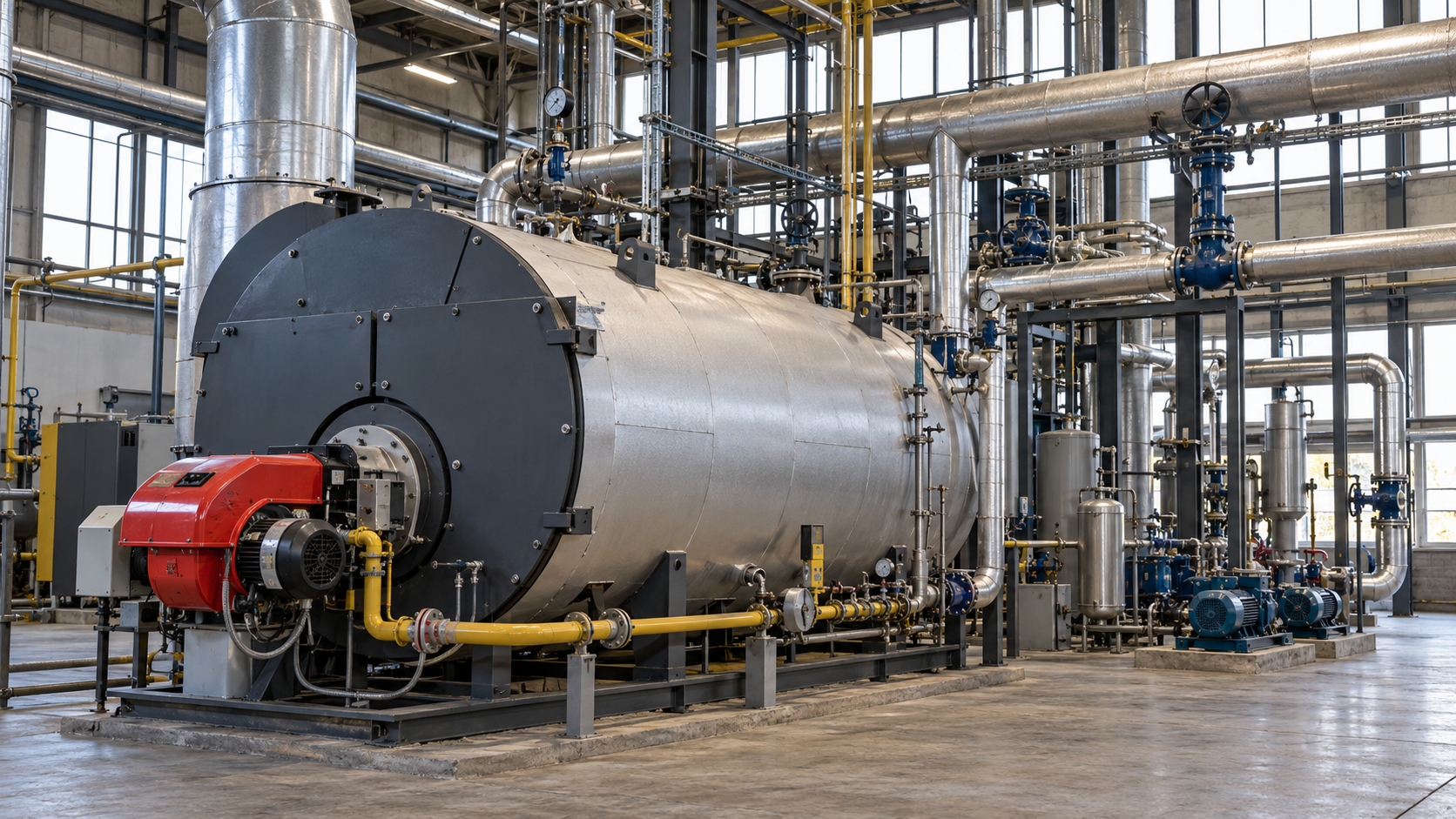
An industrial boiler plant may run without breakdowns yet consume more fuel than the facility actually needs. The problem may lie not only in boiler efficiency, but also in control settings, low-load operation, distribution losses and the conditions required by the process. An upgrade plan should therefore begin with an energy balance for the entire system, not with the choice of a replacement unit.
At a glance: what should you check before investing?
- Energy balance: how much energy enters with the fuel, and how much useful heat or steam reaches the defined measurement boundary.
- Operating profile: when demand peaks, when boilers run at minimum load and how often they restart.
- Losses: flue gas, surface and bottom blowdown, standby periods, uninsulated components, leaks and unnecessarily high operating parameters.
- Options: settings and controls, maintenance, insulation and energy recovery, followed by system modifications or replacement only after comparing the alternatives.
Where should the industrial boiler plant energy balance begin?
First define the boundaries of the analysis. The efficiency of an individual boiler and that of the whole boiler plant are two different measures. A boiler may transfer heat effectively to water or steam while the wider system still incurs significant losses during standby, distribution or water treatment.
| Balance boundary | What to measure or reconstruct | Question answered |
|---|---|---|
| Fuel input | Fuel quantity and its net calorific value over the same period | How much energy was supplied to the heat source? |
| Boiler outlet | Flow and temperatures and, for steam, pressure and specific enthalpy | How much energy do the boilers deliver? |
| Boiler plant outlet / header | Heat or steam supplied to the site’s distribution network | What share of generated heat leaves the boiler plant? |
| Process users | Demand, return conditions, operating schedule and required parameters | How much energy is actually used, and when? |
| Auxiliary equipment | Electricity consumed by pumps, fans, water-treatment systems and controls | What additional operating costs need to be included? |
In a hot-water system, thermal output can be determined from flow rate and temperature difference, taking the properties of the heat-transfer medium into account. In a steam system, mass flow and enthalpy differences matter: temperature or tonnes of steam alone cannot give a complete energy balance. Fuel comparisons must consistently use the same energy basis, such as net calorific value; for gas, units and volume-reference conditions must also be aligned.
If there are no heat meters or steam flowmeters, an estimated balance is a reasonable starting point. However, invoice and meter data must be distinguished from assumptions, and the measurements that would reduce uncertainty most should be identified. This approach is also recommended in the US Department of Energy’s Improving Steam System Performance sourcebook, which covers fuel measurement, generation losses, distribution and condensate recovery.
Where do energy losses most commonly occur?
Similar types of loss occur at many sites, but their contribution to the overall balance depends on the fuel, heat-transfer medium, age of the installation, operating profile and maintenance quality. There is no single “typical” percentage saving that applies to every boiler plant.
| Area | Diagnostic indication | Checks before making a decision |
|---|---|---|
| Flue gas and combustion | High flue-gas temperature, incorrect excess air, fouled heat-transfer surfaces | O₂ and CO analysis, flue-gas temperature, heat-exchanger condition and load during measurement |
| Part-load operation and standby | Short burner cycles; several boilers operating simultaneously at low output | Start-up log, modulation, standby duration and boiler sequencing |
| Feedwater and blowdown | High make-up water consumption and high blowdown discharge temperature | Blowdown flow, conductivity, water parameters and quality, and options for safe heat recovery |
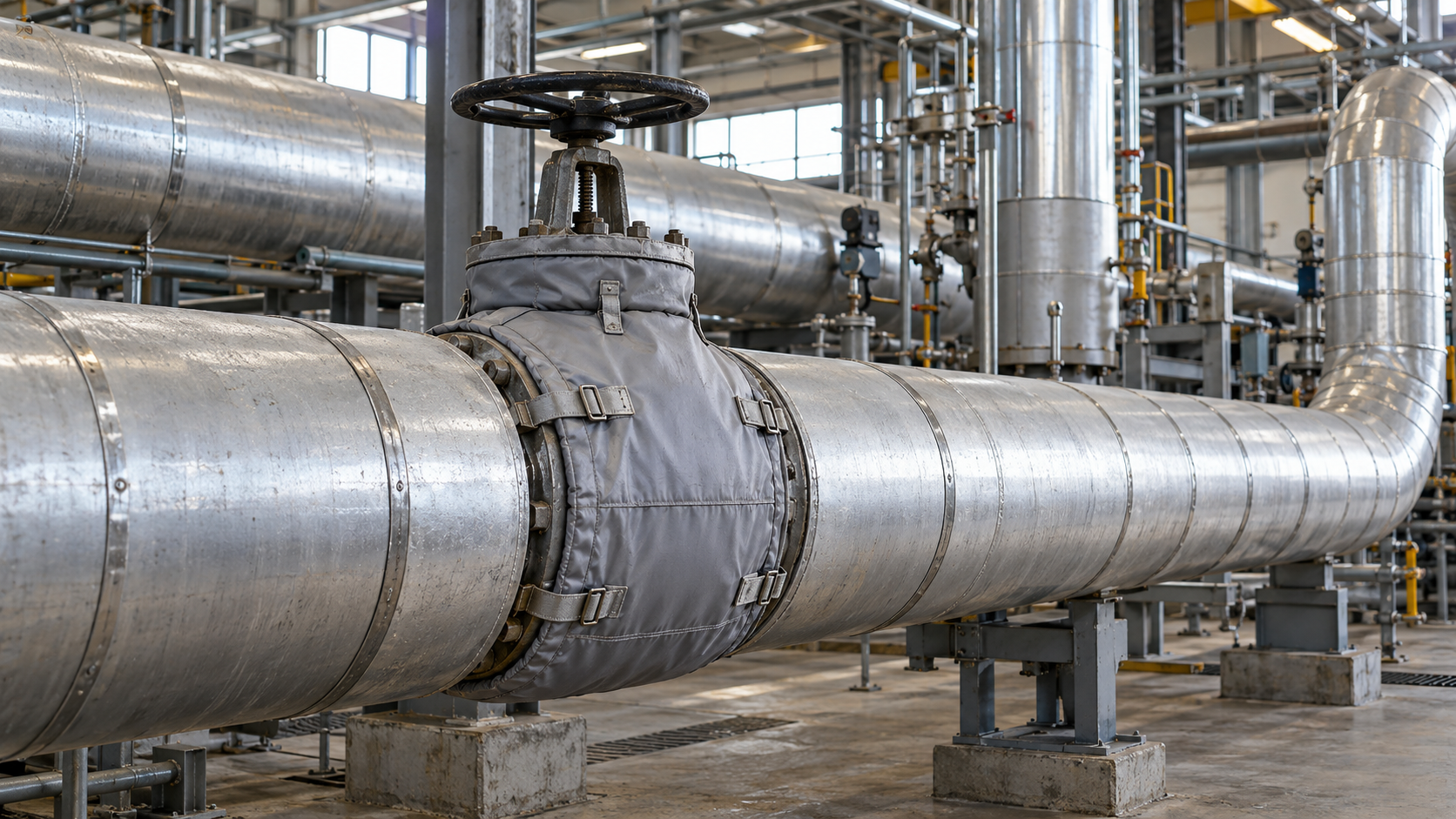
| Pipework, valves and vessels | Hot uninsulated surfaces and steam or condensate leaks | Visual inspection, temperature measurements, insulation assessment and steam-trap checks |
| Excessive process parameters | Higher temperature or pressure than the end user requires | Process requirements, pressure drops and product-quality stability |
High flue-gas temperature alone does not establish whether an economiser will pay off. The temperature and flow of the relevant medium, possible uses of recovered heat, corrosion limits and flow resistance must also be assessed. Likewise, a hot valve indicates a loss, but calculating its magnitude requires its surface area, temperature, surroundings and operating hours.
Part-load operation and boiler coordination
Demand changes throughout the site: production-line start-up, single-shift operation, cleaning, weekends and summer conditions create very different loads from the boiler plant’s rated capacity. Where two or three boilers are available, check whether the controls allocate load efficiently while maintaining the required process reserve.
Frequent burner starts and stops can be particularly costly. Each cycle includes start-up, purging and a period without full useful heat output. The DOE’s technical tip sheet on boiler short cycling notes that oversizing and running several units at low load can reduce efficiency over the operating cycle.
Before changing setpoints, compare at least three conditions: minimum stable demand, normal production and peak load. You need to know burner turndown, minimum flow, permissible load-ramp rates, pressure requirements and reserve arrangements. Reducing the number of operating boilers must not compromise steam-supply reliability, process quality or safety. Changes to protective control systems must be treated separately from routine optimisation of operational controls.
What information should you collect for a boiler plant audit?
Documents the company already holds are usually enough for an initial diagnosis. Additional measurements can then be targeted at the gaps identified.
| Data | Useful scope | Why it matters |
|---|---|---|
| Fuel and cost | Invoices and meter readings for a representative year, where available | Identify seasonal patterns and input energy |
| Heat/steam production | Meter readings, shift balances, pressure, temperatures and flow rates | Determine useful energy and load |
| Operating schedule | Shifts, weekends, shutdowns, start-ups, maintenance outages and seasonality | Compare consumption with process demand |
| Boilers and burners | Capacity, fuel, turndown range, efficiency curves, servicing and alarms | Assess part-load operation and permissible changes |
| Water and condensate | Treatment, conductivity, blowdown, make-up water and condensate return | Identify mass and energy losses |
| Pumps and fans | Power, operating hours and, where appropriate, electricity-consumption measurements | Separate auxiliary electricity use from the fuel balance |
Next, synchronise measurements of fuel consumption, heat production and process load. For example, a flue-gas analysis performed only near rated output under stable conditions will miss what happens during many hours at minimum load. Monthly data may reveal a problem, but representative hourly profiles—or shorter logging intervals, if supported by the system—are better for decisions about boiler sequencing.
As an auditor, I would first establish which quantities are measured reliably and which come from manufacturers’ documentation. Only after agreeing on the balance boundaries would I compare alternatives and estimate savings. Otherwise, it is easy to report an “efficiency improvement” that results solely from a different measurement method.
Worked example: how much fuel could be saved?
Assume that a boiler plant supplies 800 MWh of useful heat annually at a defined boundary. In the baseline case, it consumes 1,000 MWh of fuel energy, giving the system, as defined, an efficiency of 80%. For comparison, assume that planned improvements raise efficiency to 85% while useful heat demand remains unchanged.
- Fuel energy before the change: 800 MWh ÷ 0.80 = 1,000 MWh/year.
- Fuel energy after the change: 800 MWh ÷ 0.85 = 941.2 MWh/year.
- Difference: 1,000 − 941.2 = 58.8 MWh of fuel energy per year, or approximately 5.9% of baseline consumption.
A five-percentage-point gain in efficiency does not mean a five-percent fuel saving: the relationship is non-linear. The values above are illustrative assumptions, not measurements or a forecast for a specific boiler plant. The calculation excludes changes in demand, poorer performance during some operating hours, auxiliary electricity and investment costs. A real project must address these separately.
What should be upgraded before replacing the entire heat source?
A useful starting point is to compare options from the least intrusive to those requiring longer shutdowns or substantial investment. This does not mean the measures should be implemented without assessing how they interact.
| Possible measure | What it could improve | What to check before implementation |
|---|---|---|
| Adjust operating schedules and boiler sequencing | Reduce unnecessary operating hours and start-ups | Load profile, reserve, technical minimum and process safety |
| Tune combustion and maintain heat exchangers | Reduce stack losses | O₂/CO, flue-gas temperature, burner operating range and manufacturer documentation |
| Repair leaks and restore insulation | Reduce distribution losses and improve surface safety | Valve and steam-trap condition, temperature measurements and maintenance access |
| Optimise water and condensate management | Reduce energy and water lost through blowdown and make-up | Water quality, process requirements and feasibility of condensate return |
| Heat-recovery exchanger or system redesign | Use heat that currently leaves the system | Temperatures, simultaneous heat demand, fouling, resistance, costs and shutdowns |
Combustion tuning requires flue-gas analysis at representative operating points. Too little excess air may cause incomplete combustion, while too much increases stack losses. The DOE explains this in its boiler combustion-efficiency tip sheet. There is no single safe oxygen setpoint for every fuel and burner.
When is a more detailed assessment of flue gas, steam and heat recovery needed?
Flue gas and economisers
Recovering heat from flue gas makes sense where a suitable heat user operates at the necessary temperature for enough hours. The dew point of flue-gas constituents, corrosion and fouling risks, allowable pressure drop and compatibility with the chimney must also be checked. Sizing the exchanger is a separate engineering task; the preliminary boiler plant balance should first establish whether that work is worthwhile.
Steam, blowdown and condensate return
In a steam boiler plant, losses may arise from unnecessary discharge of hot boiler water, faulty steam traps, steam leaks and failure to return condensate safely. Blowdown requirements depend on water quality, pressure and the treatment programme. Reducing blowdown without monitoring water quality could damage equipment. DOE guidance addresses blowdown reduction and condensate return as separate efficiency opportunities.
Insulation, distribution network and heat users
Hot pipework, fittings and vessels merit a heat-loss assessment, but a thermal image alone does not measure annual energy loss. Calculations must allow for emissivity, ambient conditions, operating time and component geometry. The scope and limitations are explained in our guide to thermal imaging of heating installations.
If waste heat is to serve another process, compare the source’s temperature and available capacity with the user’s demand over the same hours. Our article on industrial heat recovery discusses this in more detail. The entire theoretical waste-heat quantity must not be counted as a potential saving if the heat user operates at different times.
Compliance, economics and the decision to replace boilers
When work affects pressure equipment in Poland, establish whether it constitutes a repair or modernisation under Polish technical-inspection regulations. Poland’s Office of Technical Inspection (UDT) explains the requirements for repairs and modernisation and the rules for steam boilers and hot-water boilers above 110°C. Specific obligations depend on the equipment and the work performed. Changes to safety controls must not be treated as routine operating-setpoint adjustments.
An economic appraisal should compare not only annual fuel consumption but also auxiliary energy, water, treatment, servicing, required downtime, capital expenditure and the risk to production continuity. Changes in production volume should be allowed for when comparing periods before and after an upgrade. If the heat source is obsolete or cannot meet the required demand profile, comparing alternative heat sources for the company becomes a separate step, based on the same energy balance rather than the old boiler’s rated capacity.
Some investments may qualify for Poland’s energy efficiency certificate scheme, commonly known as Polish white certificates. Eligibility and the sequence of steps must, however, be checked before entering into binding commitments or starting work. Current guidance and forms are published by the Polish Energy Regulatory Office (URE). Merely planning an upgrade does not guarantee a certificate or any particular financial benefit.
How to develop an upgrade plan step by step
- Define process requirements and balance boundaries. Record required capacity, temperatures, pressures, medium quality, operating continuity and reserve.
- Establish the baseline. Align fuel use, heat/steam production, auxiliary energy and operating schedules over a comparable period; identify missing measurements.
- Examine representative operating modes. Assess minimum load, normal production, peaks and standby separately. Check start-ups, controls, flue gas, water systems and distribution.
- Compare the options. For each, calculate energy, investment, operating costs and downtime; assess Polish UDT requirements and production risks. Do not simply add the savings of measures that affect one another.
- Plan how to verify results. Set the indicator and comparison conditions before work begins. After implementation, check process parameters and actual energy use.
If the aim is to document the benefit of a specific measure, the logical next step may be an energy efficiency audit. Its scope should reflect the proposed changes rather than replace engineering design documents or mandatory technical approvals.
What should you prepare for the first discussion about your boiler plant?
A brief description of the system and the issue is enough: fuel type, number and parameters of boilers, whether hot water or steam is produced, the operating schedule and available consumption data. If you have a process diagram, load profile or temperature measurements, include them with your enquiry. A complete dataset is not required at the outset.
Send the information you have to audytor@energytrend.pl. This allows us to identify the measurements and analyses needed to develop credible upgrade options for your industrial boiler plant.
Technical and official sources
- U.S. Department of Energy: Improving Steam System Performance – A Sourcebook for Industry – steam-system balances, generation, distribution and recovery.
- U.S. Department of Energy: Minimize Boiler Short Cycling Losses – losses from frequent starts and part-load operation.
- Polish Office of Technical Inspection (UDT): repairs and modernisation – approval requirements for work on equipment subject to technical inspection in Poland.
- Polish Energy Regulatory Office (URE): energy efficiency certificates – official information and forms for Poland.