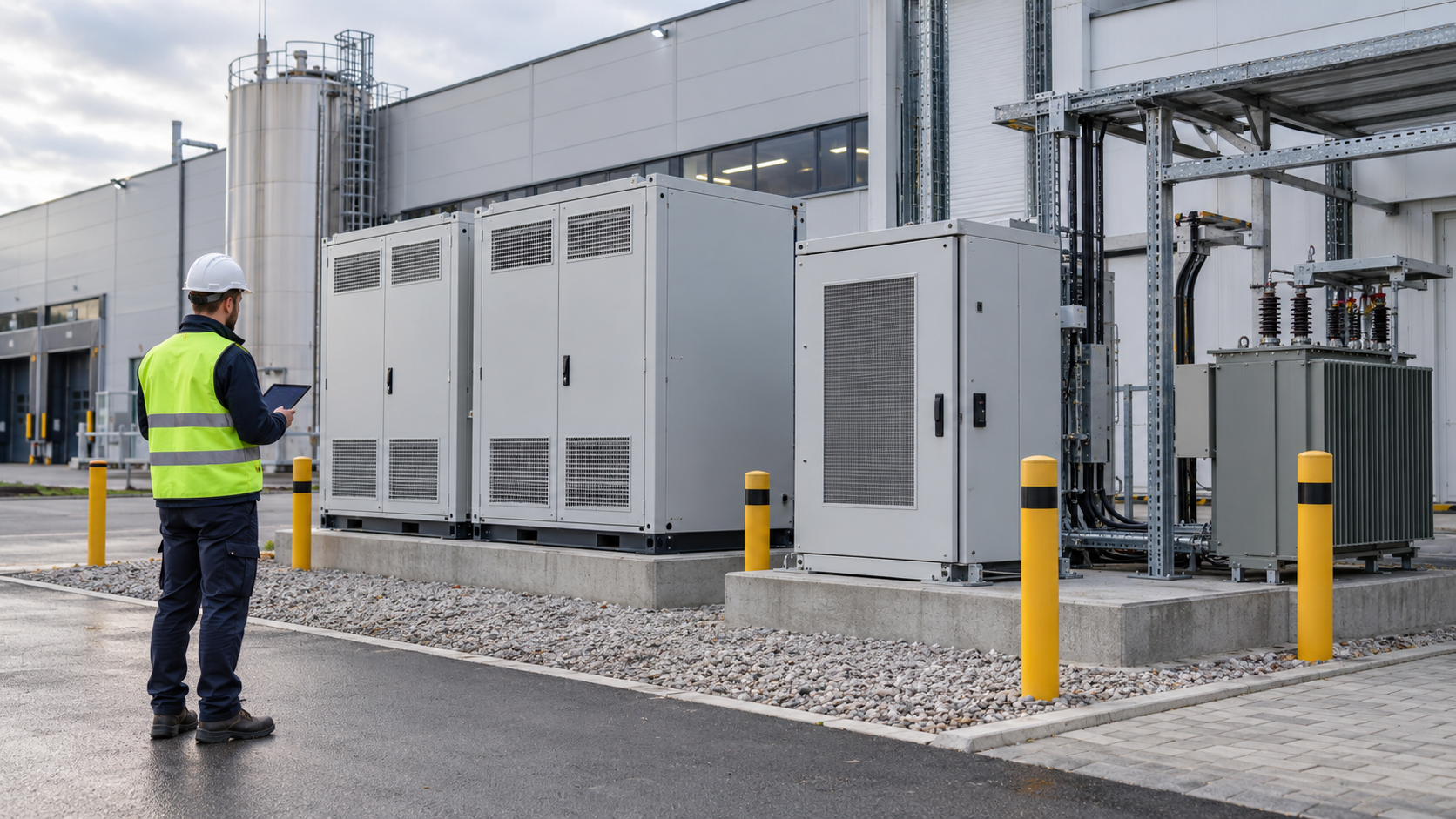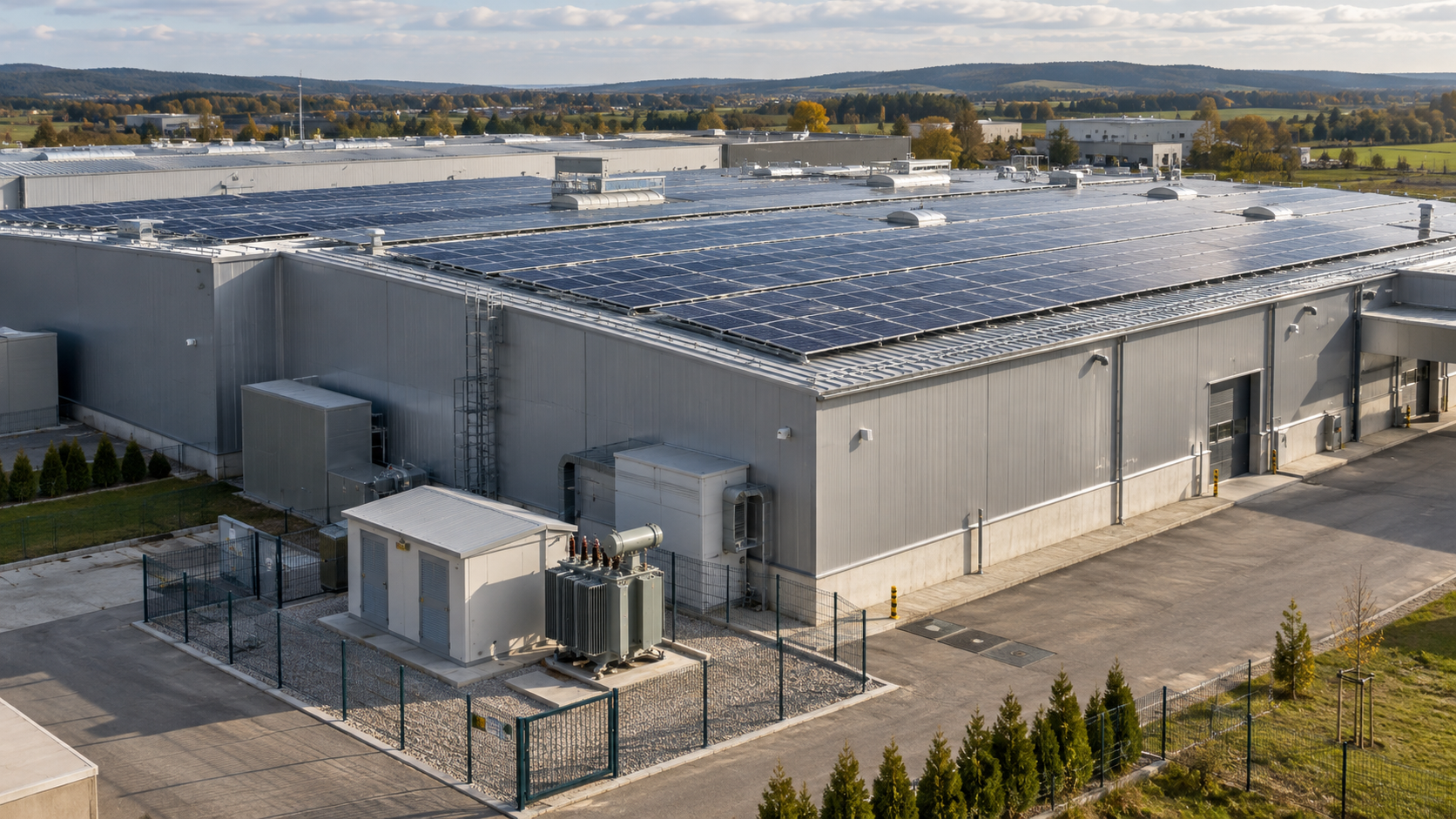
An on-site photovoltaic (PV) system can substantially reduce the amount of electricity a facility buys from the grid without necessarily lowering its maximum grid demand. Whether contracted capacity can be reduced depends primarily on how closely PV generation coincides with the facility’s periods of highest demand. Before changing the agreement, the grid import profile needs to be examined, not just annual energy savings.
Can solar PV reduce contracted capacity?
Yes, but not automatically. PV reduces grid demand while its output is supplying equipment in operation. If the highest load occurs before sunrise, after sunset or when generation is low, however, the installation may have virtually no effect on peak grid demand.
Contracted capacity is a parameter specified in the electricity supply or distribution agreement. It is not the rated power of the panels or the sum of the facility’s equipment ratings. Under the applicable Polish tariff regulation, it relates to active power drawn from or fed into the grid, determined with reference to average power over 15-minute intervals. Section 53 of that regulation sets out the monitoring and charging rules for exceeding contracted capacity.
For an installation serving on-site demand, three distinct quantities therefore need to be considered:
- Facility load – the power required by machinery, ventilation, refrigeration and other equipment.
- PV generation – the actual AC-side power output, which varies with solar irradiance and operating conditions.
- Grid import – the power measured at the contractual metering boundary with the network operator, after accounting for PV generation consumed on site.
A 300 kWp installation does not mean that 300 kW can be subtracted from existing contracted capacity. kWp denotes the modules’ rated capacity under standard test conditions; for billing purposes, what matters is the actual power profile at the grid connection. Connection capacity and the conditions for exporting surplus electricity are separate issues and must not be confused with the ability to reduce contracted import capacity.
Why might peak grid demand remain unchanged?
Many industrial facilities reach their maximum demand when several energy-intensive machines start up together or when an entire shift is operating. If this occurs in the evening, in winter or on a cloudy day, solar panels cannot provide a predictable reduction in the peak. Even in a facility operating only during daylight hours, the worst 15-minute interval may coincide with a temporary drop in sunlight.
Consider a facility with 600 kW of contracted capacity and a PV installation. The values below are illustrative averages for selected 15-minute intervals on a single day, without battery storage or electricity export:
| Time | Facility load | PV generation | Grid import |
|---|---|---|---|
| 06:00 | 480 kW | 0 kW | 480 kW |
| 11:00 | 520 kW | 250 kW | 270 kW |
| 14:00 | 450 kW | 180 kW | 270 kW |
| 18:00 | 560 kW | 0 kW | 560 kW |
At midday in this example, grid import falls by 250 kW, yet the highest demand among the intervals shown is still 560 kW. Reducing contracted capacity from 600 to 400 kW solely on the basis of daytime PV generation would create a risk of a 160 kW exceedance in the evening interval shown. This illustrates the mechanism, not the resulting charge: assessing charges requires the full profile and the settlement rules for the specific supply point.
This distinction matters particularly in multi-shift operations. A reduction in annual electricity purchases measured in kWh does not demonstrate an equivalent reduction in maximum demand measured in kW. Nor is one favourable summer electricity bill sufficient.
How can you measure PV’s actual effect on grid demand?
1. Define the metering boundary and align the data
The analysis must relate to a specific electricity supply point (PPE, under the Polish metering system) or to a set of supply locations settled together under the agreement. A demand or energy profile from the settlement meter is needed, preferably at 15-minute resolution and covering a full year with different operating conditions. If the operator provides electricity consumption in kWh per quarter-hour, the average active power for that interval is calculated by dividing the energy by 0.25 hours.
This must be matched with inverter generation data on the AC side and, where applicable, electricity exported to the grid. The data should cover exactly the same time intervals, taking account of daylight-saving time changes, gaps in measurements and differences between meters. The grid-import profile alone, measured after PV installation, does not reconstruct the facility’s full load: some electricity was consumed on site without passing through the grid import meter.
2. Examine demand peaks, not just averages and total energy
The analysis should identify the dates and causes of the highest demand levels, the time of day, season, production shift and actual PV output during those same intervals. Low-generation days, PV downtime, expected load growth and the commissioning of new equipment must also be considered. Only then can you establish whether lower demand during sunny hours also affects the periods that determine contracted capacity.
For a planned installation, a generation model can help, such as the European Commission’s PVGIS hourly data. Such a model helps assess seasonality but cannot replace an analysis of the most demanding 15-minute intervals or actual site measurements. In particular, hourly averages must not be treated as a guarantee of the power available in every quarter-hour.
3. Compare scenarios against the agreement terms
The output should compare several realistic contracted-capacity levels, potential exceedances and their costs under the operator’s current tariff. Check whether capacity is contracted for the full year or can vary by month, and what conditions apply to changes. Section 54 of the Polish tariff regulation refers these matters to the agreement. In the case described in subsection 2, a reduction approved by the energy undertaking entails a 10% increase in the fixed network charge component for the period covered by the reduction.
A lower fixed charge must therefore not be the only factor compared. The chosen scenario must withstand poorer weather, seasonal peaks and the facility’s foreseeable growth. The general approach is explained further in our article on how to select contracted capacity.
When can load control or battery storage help?
If PV reduces grid import mainly around midday while peaks occur at other times, organisational and technical options are worth comparing:
- Rescheduling loads – for example, adjusting charging schedules, auxiliary system operation or selected activities, where the process and safety requirements allow it.
- Automatic load limiting – controlling selected loads according to real-time demand at the grid boundary, while prioritising critical processes.
- Battery energy storage – discharging during peaks, provided the system has sufficient power, usable energy and state of charge at the required time.
For example, reducing grid import by 100 kW for 30 minutes requires at least 50 kWh of delivered energy. The storage system must provide both 100 kW of discharge power and sufficient usable energy; its nominal capacity should also allow for losses, operating reserves and ageing. Controls must prevent the battery from charging at times when charging itself would raise grid import above the selected limit.
This is a scenario to simulate against a chronological demand profile, not an automatic recommendation to purchase a battery. Curtailing PV exports, meanwhile, primarily affects surplus electricity fed into the grid; by itself, it does not guarantee a reduction in maximum grid import. Sizing solar PV for industrial facilities requires a separate assessment of objectives and technical constraints.
What data should you collect before changing contracted capacity?
Before applying to the supplier or network operator, gather:
- the current agreement and tariff group, contracted capacity and connection capacity for the supply point;
- at least 12 months of grid import data, preferably at 15-minute resolution, and bills showing any capacity exceedances;
- PV module capacity (kWp), inverter capacity (kW) and the actual or forecast AC-side generation profile;
- information on electricity exports, generation curtailment, battery storage and control arrangements;
- shift schedules, seasonality, new equipment and plans to increase or reduce production;
- the current rules for changing contracted capacity and the tariff rates of the operator serving the location.
If some data are unavailable, start with the bills, agreement and a description of the planned installation. An incomplete demand profile does not, however, justify a specific reduction in contracted capacity. Meter data can be obtained according to the facilities offered by the relevant operator; for example, TAURON describes access to hourly and 15-minute profiles through its eLicznik service.
From an energy auditor’s perspective, I would first examine several of the most demanding days with little or no PV generation, together with comparable days after any changes to operating schedules. If these days determine the peaks, installing panels alone is not sufficient grounds for reducing contracted capacity. Only a demonstrable, repeatable reduction in demand during critical intervals justifies preparing scenarios for discussion with the network operator.
What next?
If your company already has PV or is planning an installation, the first step is to compare demand and generation profiles with the current agreement terms. An electricity cost optimisation assessment can establish whether changing contracted capacity is justified and what risks arise during periods of low PV output.
Use the Energy Trend contact form to send a brief description of the installation and the data available: tariff group, contracted and connection capacity, demand or generation profile, and the facility’s operating schedule. A complete set of measurements is not required for the initial enquiry; the scope of further analysis can be agreed once the materials have been reviewed.
Sources
- Polish Minister of Energy Regulation of 3 September 2026, Journal of Laws 2026, item 1182 – capacity definitions, Section 53 on exceedances and Section 54 on changes to contracted capacity.
- TAURON Dystrybucja: amendments to agreement terms – separate procedures for changes to contracted and connection capacity.
- TAURON Dystrybucja: demand and generation profile data – use of 15-minute profiles.
- European Commission, JRC: PVGIS – Hourly radiation – scope of hourly modelled PV generation data.
- IEA: Electricity 2026 – Flexibility – the role of demand management and storage in limiting peaks and their availability constraints; findings concern electricity systems, not data from an individual facility.