Capacitive reactive energy can lead to distribution charges even when a plant consumes very little active energy. Cables, equipment filters or an incorrectly operating compensation system may be responsible. Before investing in reactors or an active compensator, a company should establish when and where in its electrical installation the excess occurs.
What is capacitive reactive energy?
Reactive power is part of the flow of electrical energy in an alternating-current network. It does not represent active energy consumed to perform useful work, but it affects current levels and network operating conditions. In simplified terms, an inductive load draws reactive power, while a capacitive load supplies it back to the network at the measurement point. Both types of equipment may operate in the same installation; billing depends on what is measured at the electricity delivery point.
Reactive power is usually expressed in kvar, while its accumulated amount over time is measured in kvarh or Mvarh. These should not be confused with active power in kW or active energy in kWh. The billing meter may record reactive energy separately by direction and measurement quadrant. A single cos φ or tan φ (tg φ) value, without information about the meter configuration, is therefore not enough to attribute a charge to a particular device.
How can you identify the charge on a distribution invoice?
On a detailed Polish distribution invoice, look for entries such as “energia bierna pojemnościowa” (capacitive reactive energy), “energia bierna oddana” (reactive energy exported) or “ponadumowny pobór energii biernej – pojemnościowej” (excess capacitive reactive energy). Wording and presentation differ between operators. Record the billed quantity, unit, billing period and amount. Also check the distribution system operator (DSO), tariff group and voltage level at the delivery point.
The legal basis for billing in Poland is the Regulation of the Polish Minister of Energy of 3 September 2026, particularly § 52, together with the relevant operator’s approved tariff. The rules distinguish excess inductive reactive energy from capacitive reactive energy. The default tg φ0 = 0.4 applies to the billing of inductive reactive energy; it is not a free allowance for exporting capacitive reactive energy. Capacitive energy is billed according to the recorded amount in controlled time zones or around the clock, depending on the metering arrangement.
Low active-energy consumption therefore does not automatically prevent a charge. Not all installations are billed in the same way: Polish regulations cover customers supplied at medium, high and extra-high voltage, and may also apply to low-voltage customers. For each metering point, check the contract, tariff and meter readings. Our electricity distribution invoice analysis explains other cost items.
Why does capacitive reactive energy occur at low loads?
During production, motors and other inductive loads can partly offset the capacitive characteristics of an installation. When a shift ends, active and inductive loads decrease, but some cables, filters and devices remain energised. The balance measured at the billing point may then shift from inductive to capacitive.
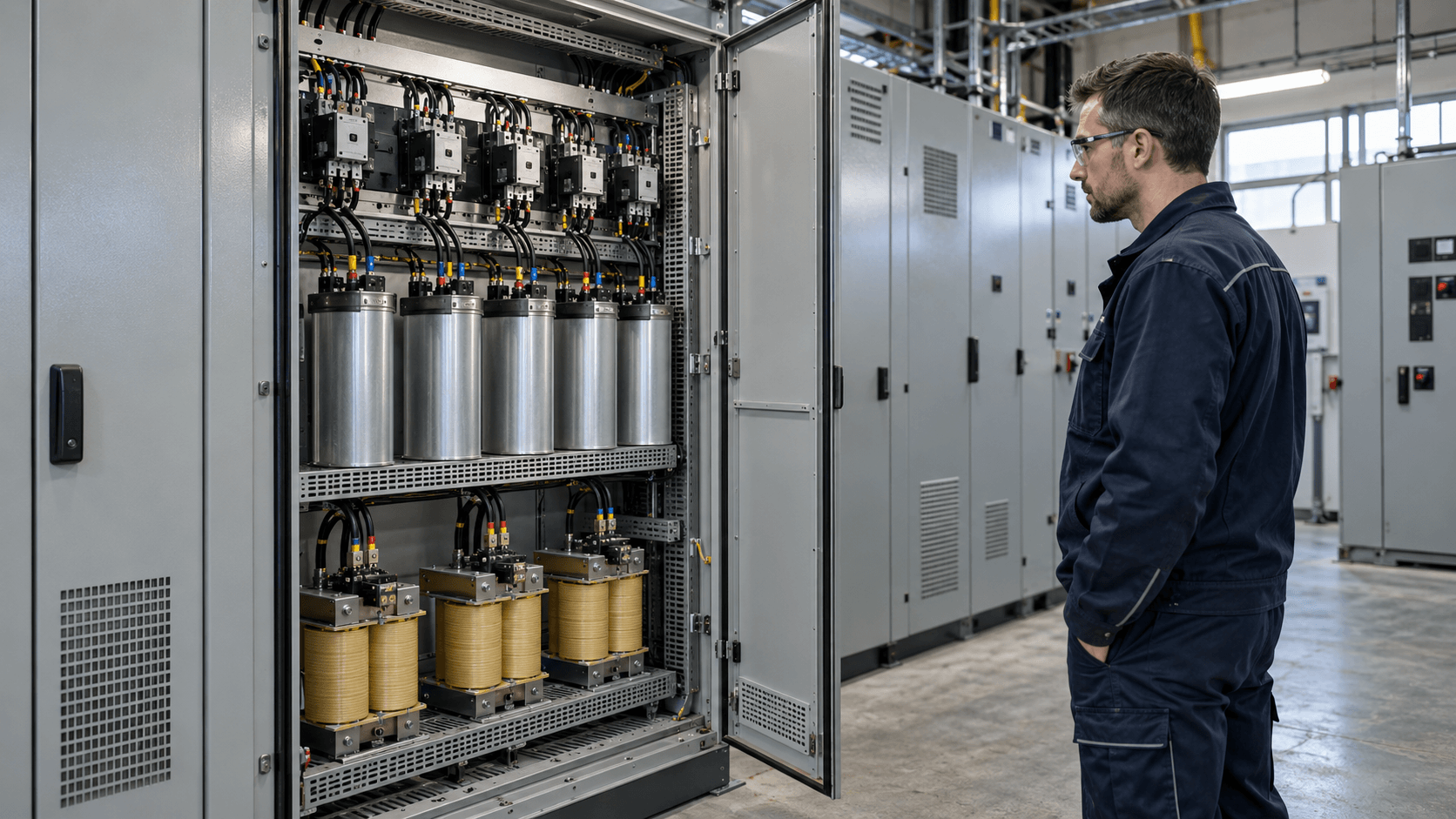
A similar effect occurs with overcompensation: capacitor-bank stages remain switched on after the load they were intended to compensate has disappeared. The mere presence of a compensator does not prove that it caused the charges. Reactive power measurements must be compared with the operation of individual stages and connected loads.
For example, a continuous capacitive reactive power of 5 kvar during a 12-hour shutdown each day for 30 days corresponds to 5 kvar × 12 h × 30 = 1800 kvarh, or 1.8 Mvarh. This simplified constant-power scenario illustrates the quantity of reactive energy involved. The actual meter accumulates energy according to its configuration and the DSO’s billing rules.
What can cause capacitive reactive energy?
| Installation component | Possible mechanism | What to check |
|---|---|---|
| Long circuits and cables | Cable capacitance causes capacitive current to flow even at low loads; its significance depends, among other things, on cable length, voltage and construction. | Energised sections, network configuration and measurements during shutdown. |
| Capacitor bank | Connected stages may supply more capacitive reactive power than is needed to offset the inductive load. | Controller settings, stage ratings, contactors, current transformers and switching history. |
| Power supplies, filters, UPS systems and electronics | Input filters and control methods can alter the reactive power balance, particularly at partial load. | Operating modes, technical data, measured P and Q values and current distortion. |
| Installation after modernisation | Changes to equipment or operating profiles can reveal an excess that was not apparent under the previous load balance. | Profiles before and after the change and the condition of existing compensation, without assuming that the new technology itself is at fault. |
LED lighting and photovoltaics can affect the balance, but not every LED luminaire or inverter behaves the same way. Assessment requires equipment-specific data and measurements. We discuss the operation of PV installations separately in our article on reactive energy and photovoltaics.
What data is needed to identify the cause?
Start at the billing meter and work back through the internal electrical installation. The invoice reveals the financial impact but does not, by itself, identify the source.
- Invoices and billing rules: collect available invoices from different months, detailed reactive-energy charges, the DSO tariff, metering-point details and contract terms. Several months can reveal recurring patterns; a full year makes seasonality easier to assess.
- Operating hours: compare production hours, night-time shutdowns and weekends with the operating schedules of server rooms, refrigeration, UPS systems and any PV installation. Look for a relationship between changes in load and the amount of reactive energy.
- Active and reactive power profiles: check whether the DSO provides P/Q data in 15-minute intervals and reactive-energy registers for the relevant directions. A P profile in kW alone is insufficient. Interpret the sign of Q and the quadrants according to the meter documentation.
- Existing compensation: record the equipment type, stage ratings, controller settings, contactor condition, current-transformer positions and any alarms. Do not alter settings or connections without an assessment by a suitably qualified person.
- Measurements within the installation: if DSO data does not establish the cause, record P, Q, voltages, currents and, depending on the loads, harmonics. Measurements should cover a representative operating cycle and shutdown at appropriate network points.
How should you interpret a P/Q profile?
If the capacitive condition occurs mainly after production stops, the first hypotheses are the capacitance of circuits that remain energised or overcompensation at low load. If it occurs while a particular production line operates, examine that line’s filters and power supplies. If the profile changes when a capacitor-bank stage switches on, investigate the controller. These are diagnostic clues, not a diagnosis without measurements.
Where many different loads operate, assess current distortion and resonance risk as well. A detuning reactor in a capacitor bank does not perform the same function as a reactor used to compensate excess capacitive reactive power. Selecting a solution requires consideration of both issues.
How can capacitive reactive energy and the associated charges be reduced?
Identify the source first, then select a corrective action. Expanding an installation based solely on the monthly invoice amount can result in incorrectly specified equipment.
| Possible action | When to consider it | Points to watch |
|---|---|---|
| Adjust settings or repair existing compensation equipment | When measurements show unnecessary capacitor stages remaining connected or incorrect measurements at the controller. | The controller, current transformer and protective devices must match the actual circuit configuration; do not disable protection. |
| Change the circuit configuration | When unused, permanently energised sections or devices have been shown to make a material contribution. | Do not compromise safety, continuity of supply or process requirements. |
| Reactor bank for compensating capacitive reactive power | When a predictable excess of capacitive reactive power needs to be balanced by an inductive load. | The reactor rating, step arrangement, protection and harmonic conditions require an engineered design. |
| Active reactive power control system | When the magnitude or direction of Q changes rapidly, or continuous control in both directions is needed. | Check the specific device’s capabilities, operating range and business case; harmonic-filtering functions are not automatically equivalent to Q compensation. |
Our guide to reactive power compensation covers general principles and common specification mistakes. For dynamic loads, it is also helpful to compare active compensators and capacitor banks. Manufacturers’ documentation, including Schneider Electric’s information on power-factor correction and power-quality equipment, shows how control ranges and functions differ between devices.
How does the operator calculate capacitive reactive energy charges?
Under § 52(8) of Poland’s electricity tariff regulation, the charge for capacitive reactive energy is calculated as the product of the billed reactive energy quantity, multiplier k and price Crk defined by the regulation, using consistent units. The multiplier k is 0.50 for high/extra-high voltage, 1.00 for medium voltage and 3.00 for low voltage. The applicable voltage level is determined at the electricity delivery point, and Crk is set under the rules in force when the DSO tariff is approved. It must not be replaced with an arbitrary electricity purchase price from the supply contract.
In the earlier example, 1.8 Mvarh is the calculated quantity based on an assumed power profile. If the meter recorded the same quantity as billable energy, the product would be 1.8 × 1.00 × Crk for a medium-voltage connection and 1.8 × 3.00 × Crk for a low-voltage connection. The actual charge depends on the applicable tariff, consistent units and measured consumption; this example is not a bill forecast. TAURON Dystrybucja publishes guidance on reactive energy billing.
How can you verify that the solution works?
After implementation, compare P/Q measurements before and after the change under similar operating hours, load levels and conditions. Analyse shutdown and production periods separately. Check that reducing exported capacitive reactive energy has not caused insufficient inductive compensation, undesirable switching or deterioration in power quality.
Then compare the relevant charge on the next distribution invoice, allowing for the billing-period length and tariff. A lower charge is an important indicator, but a full assessment also requires checking the recorded profiles. If the cause varies over time, a single favourable reading after commissioning is not enough.
Where should a company start?
As an energy auditor, I would first compare invoices with plant operating hours and check whether the charge increases during shutdowns. Only then would I assess compensation settings and the need for additional equipment. This sequence helps avoid purchases based solely on the billed amount.
To discuss the next steps, describe your installation and send Energy Trend any available invoices, operating hours, P/Q profiles and details of existing compensation equipment. You do not need a complete set of measurements for the initial conversation. This issue can also be addressed as part of broader electricity cost optimisation; you can share the data using the Energy Trend contact form.
Sources
- Regulation of the Polish Minister of Energy of 3 September 2026 (Journal of Laws 2026, item 1182), § 52 – the legal basis for reactive energy billing rules and multipliers in Poland.
- TAURON Dystrybucja: reactive energy – an operator’s explanation; the tariff of the DSO serving the relevant metering point applies.
- Polish Energy Regulatory Office (URE): how to optimise electricity costs – the nature of the charges and compensation options.
- Schneider Electric: power-factor correction and power-quality equipment – differences between the functions of technical solutions.