A company rarely modernises only one element of its energy system. In practice, building energy retrofits, heat recovery, heat-source replacement, process electrification, photovoltaics, cogeneration, energy storage, drive upgrades and new control systems often appear side by side. Each of these investments may be justified on its own. The problem begins when each is designed from a different energy balance without considering how it will change the parameters used for subsequent projects.
The most important rule is simple: the next investment should not be sized to a consumption profile that earlier measures are expected to change. If heat demand falls after a building energy retrofit, a heat source sized beforehand may be too large. If heat recovery covers part of the process demand, both the required capacity and the operating hours of the new source will change. If a heat pump or another form of process electrification is introduced, the electricity profile previously used to plan photovoltaics or energy storage will change as well.
Energy system modernisation should therefore be treated as a technical project built around the interdependencies between investments. The objective is not to create another equipment list, but to establish the sequence, shared design assumptions and target energy profiles after each stage.
Energy system modernisation is about managing interdependencies, not compiling a technology catalogue
The most common mistake is to assess every investment against the current state. A building audit determines demand before the energy retrofit, the heat-source designer uses the same baseline, the PV supplier analyses historical electricity consumption, and the energy storage system is sized to a profile that will no longer exist after the other investments are implemented.
In a coherent approach, the historical balance is not the only reference point. A residual energy balance must also be developed, meaning the forecast demand after the measures planned earlier have been implemented. This balance becomes the input for the next stage.
Auditor’s note: when several upgrades are being planned in parallel, I am more interested in the post-modernisation energy profile than in the total historical consumption. The future profile should determine source capacities, renewable-energy parameters, the role of storage and the control logic.
This approach is consistent with the “energy efficiency first” principle. Article 3 of Directive (EU) 2023/1791 requires Member States to ensure that energy-efficiency solutions are assessed in specified planning and policy decisions and major investments. This does not mean that the Directive imposes the project sequence described below on every company. In this article, the sequence is a technical design practice: first update demand and losses, and only then select how the remaining demand will be supplied. This helps reduce the risk of oversizing and conflicts between investments.
What can go wrong when investments are designed separately?
- Oversizing the heat source. A boiler, heat pump or other installation may be sized for demand before the building energy retrofit, heat recovery or process changes.
- Oversizing the energy storage system or assigning it the wrong role. Storage sized to today’s profile may no longer fit the profile after PV commissioning, heating electrification, production-schedule changes or an increase in machine power.
- Conflict between cogeneration and heat recovery. Both investments compete for the same heat demand. If heat recovery reduces the baseload heat demand, the cogeneration unit may have fewer hours of efficient operation.
- Double-counting savings. Two projects may attribute to themselves the reduction in the same portion of energy consumption, even though after the first project is implemented the second is already operating against a lower baseline.
- Incorrect assessment of grid connection capacity. Electrifying heat generation, cooling or a process can increase peak electricity demand even if total final energy consumption falls.
- Controls designed too late. Individual devices may be technically correct, but without an agreed operating hierarchy they may compete for the same demand, charge the storage system at the wrong time or create unnecessary power peaks.
Which sequence of energy system modernisation makes the most sense?
There is no single sequence that applies to every site, but in most analyses it makes sense to move from reducing demand to deciding how the remaining demand will be supplied. This allows each subsequent device to be sized against an increasingly realistic target profile.
1. Start by establishing the actual energy profile and technical constraints
The starting point should be an energy balance broken down not only by energy carrier but also by time and area. Annual electricity or gas consumption is too coarse for sizing many technologies. The analysis should include, among other things, electrical load profiles, the seasonality of heating and cooling demand, production-line operating hours, temperature parameters and information on grid-connection and process constraints.
For electricity, 15-minute or hourly data are often used. For heat, it is equally important to separate building, process and domestic hot-water demand, because each group may have a different time profile and different temperature requirements.
2. Reduce demand and losses before sizing new sources
The first step is to analyse measures that reduce the amount of energy required to perform the same work. Depending on the site, these may include building energy retrofits, reducing losses in thermal installations, compressed-air optimisation, upgrades to refrigeration, lighting, production technologies, motors and electric drives.
For drives, it is not enough to assume that a variable-frequency-drive upgrade automatically delivers a fixed percentage of savings. The effect depends on the characteristics of the driven machine, actual load, required control and operating point. If the pump, fan, hydraulic system or process parameters are changed at the same time, VFD savings must be calculated at the new operating point rather than added to the effects of the other changes as an independent value.
3. Then make use of energy that is already available on site
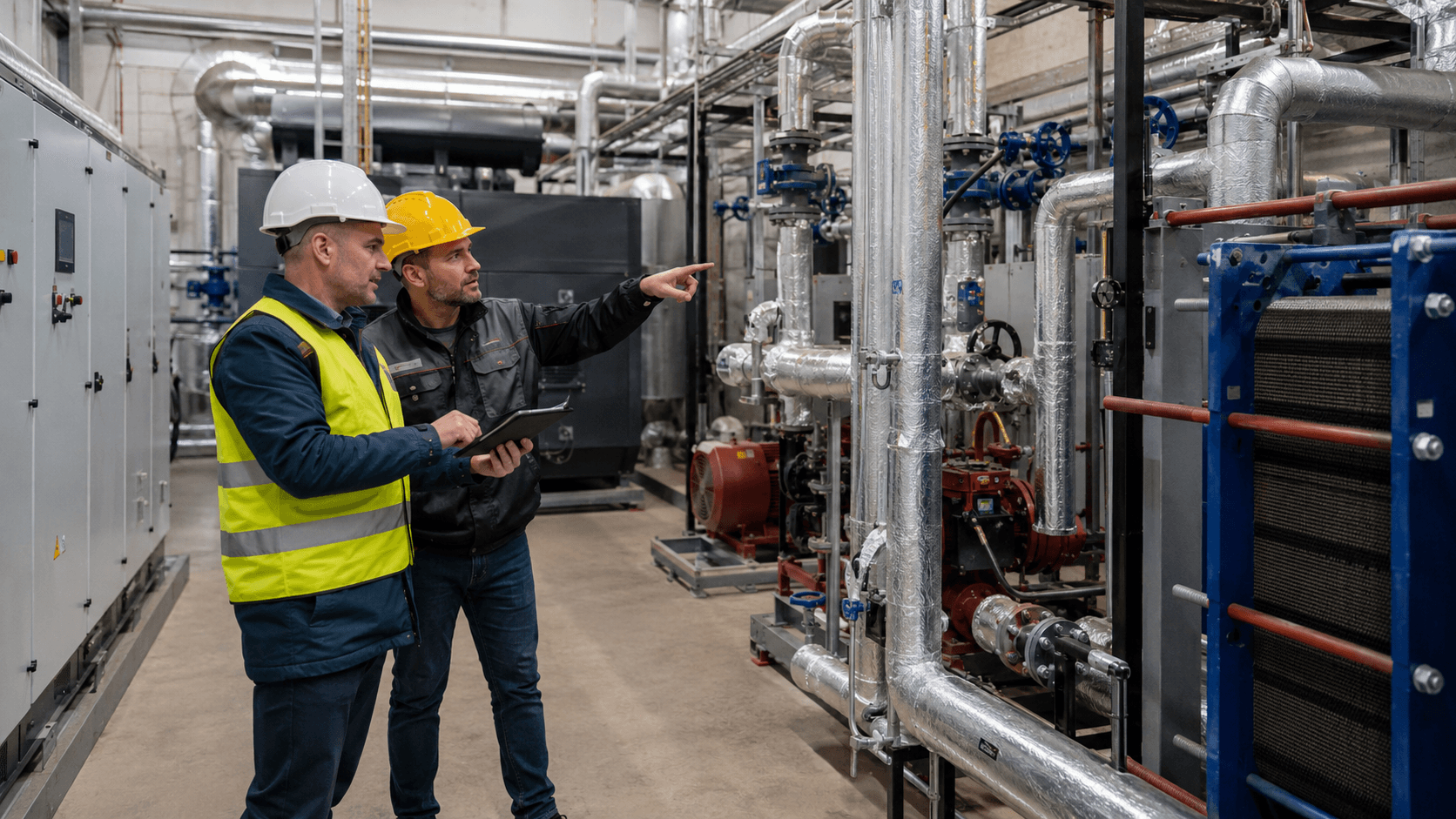
After unnecessary consumption has been reduced, it is worth assessing waste heat recovery. Potential sources include compressors, refrigeration units, flue gases, hot products, process exhaust air and other process media.
The mere presence of a high temperature does not mean that heat recovery will be useful. Three factors must be considered together: the thermal power available, its temperature level, and the simultaneity of the heat source and heat demand. If heat is available when the site has no use for it, the annual potential will be much lower than the instantaneous thermal power might suggest. Sometimes the issue can be addressed with thermal storage, a schedule change or a heat pump, but these are additional elements that also need to be assessed in the shared model.
4. Only after demand reduction and heat recovery, recalculate residual demand and size the sources
A new heat source should be sized to the load that remains after the earlier measures have been accounted for. This applies to boilers, heat pumps, district heating, electric heat sources and cogeneration.
This does not mean that every source should simply be sized to the residual load. Backup requirements, heat-recovery reliability, design temperatures, minimum equipment capacity, modulation range, process shutdowns and emergency scenarios must also be considered. The key point is that all these decisions should be made using the updated balance rather than pre-modernisation data.
5. Size renewables to the new demand profile, not only to annual consumption
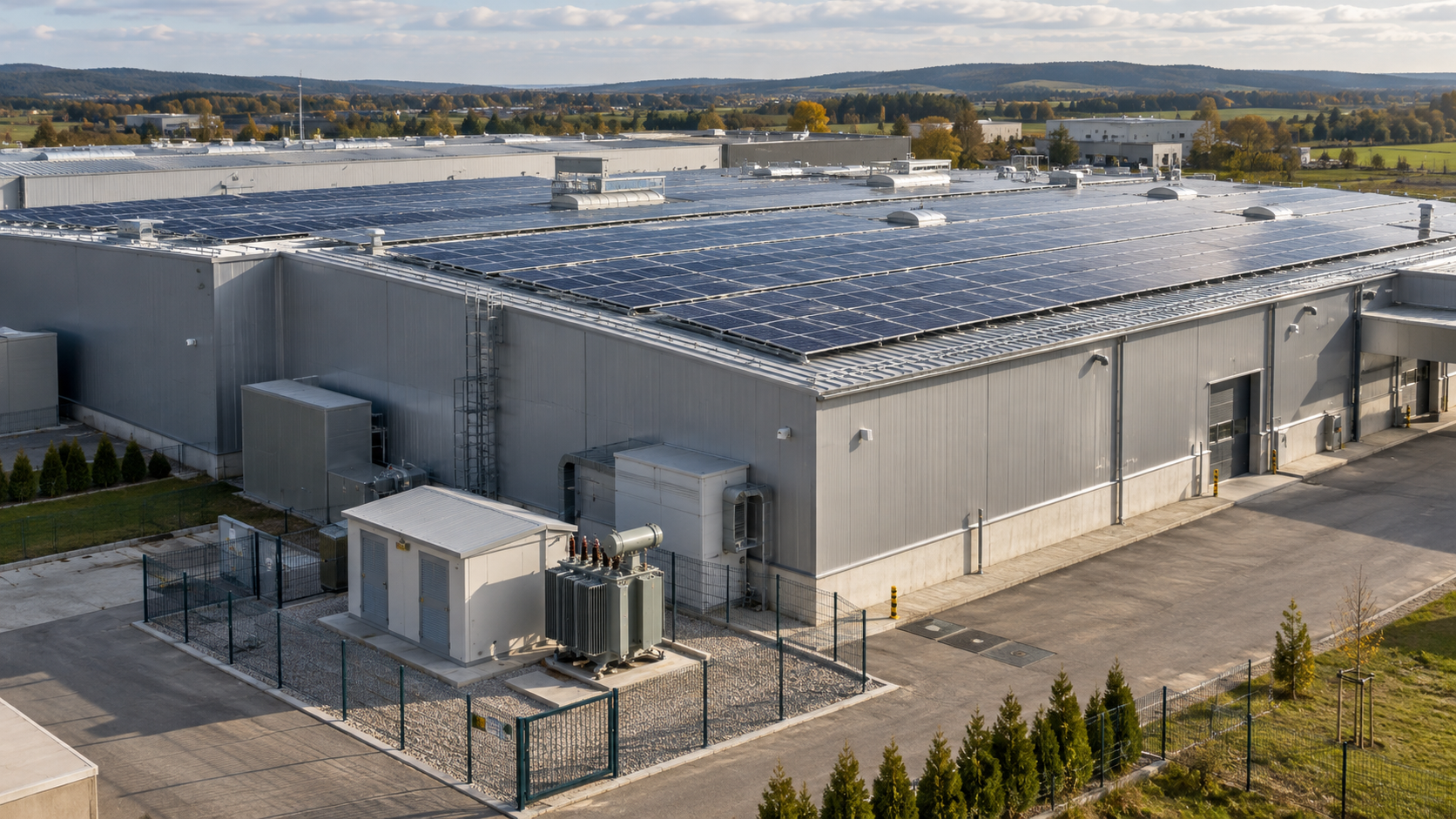
Once demand-side changes have been incorporated, on-site generation can be considered. For industrial photovoltaics, it is particularly important to compare generation and consumption in the same time intervals. Tools such as PVGIS can provide hourly PV-generation data, but these data must be compared with the site’s actual or forecast load profile.
Other technologies, such as wind power, biogas or hydrogen, may also form part of the modernisation if they suit local conditions, fuel or energy availability and the company’s operating profile. They are not, however, a mandatory component of a coherent system simply because they are technically feasible.
6. Size energy storage only after defining its function
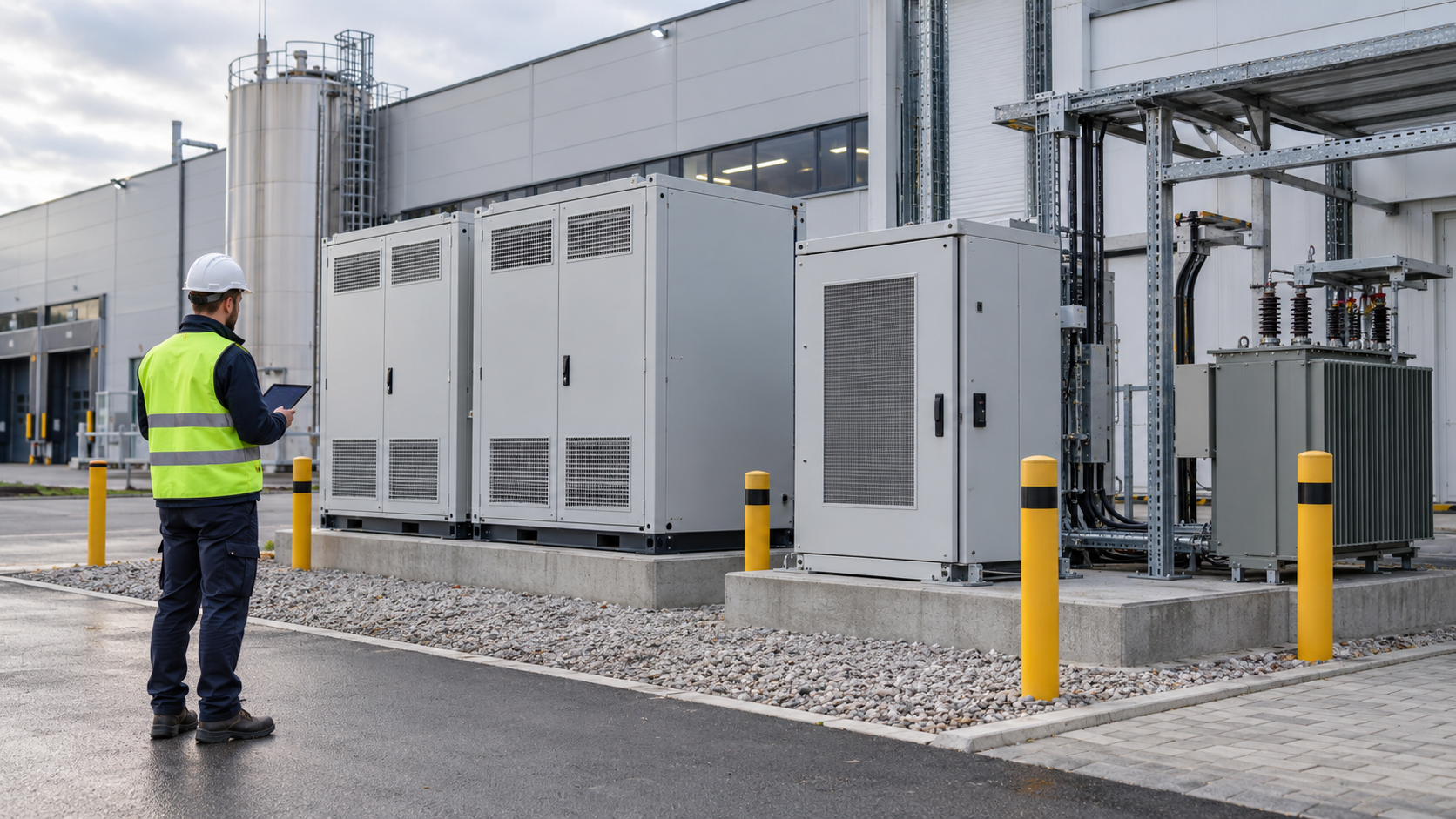
Energy storage should not be treated as a universal add-on to PV. First define what it is intended to do: increase self-consumption, reduce peak grid demand, shift energy between time periods, support backup power, or combine several functions.
At least two parameters are required for correct sizing: power in kW and usable capacity in kWh. The same power peak can require very different energy capacity depending on its duration. Equally important are the control logic, available state-of-charge range, efficiency, reserve for other functions and grid-connection constraints.
Federal Energy Management Program materials (U.S. Department of Energy) distinguish between the specification and design stage of a BESS and the subsequent assessment of its operation using actual charging and discharging data. From a design perspective, the practical conclusion is that the storage function and success criterion are defined first, and only then its power, capacity and controls are selected. A system optimised for short-duration peak shaving does not automatically become a properly sized backup-power system.
7. Finally, integrate the installations with a common control logic
Controls are the last element of this sequence only in terms of final configuration. Automation requirements must be defined from the start of the project, because they influence meter selection, device communications, modulation capability and supplier interfaces.
Depending on the site, a supervisory system may coordinate, among other things, heat-recovery use, source dispatch order, storage charging and discharging, heat-pump operation, peak reduction and response to PV generation. An EMS or properly designed automation does not “create” savings by itself. It does, however, enforce the assumptions previously quantified in the energy balance and operating scenarios.
We discuss measurement tools and automation in more detail on our energy monitoring and management page.
How does one modernisation change the sizing conditions for the next? Practical examples
Building energy retrofit and heat-source capacity
Assume that at the design point a facility requires 900 kW for space heating and 300 kW for other heat loads, for a total of 1.2 MW. If the building energy retrofit reduces the building-related component by 30%, space-heating demand falls from 900 to 630 kW. With the other loads unchanged, the new balance is approximately 930 kW.
A source previously sized at 1.2 MW would, in this simplified comparison, be 270 kW larger than the new demand. This does not automatically mean that the correct equipment capacity should be exactly 930 kW — reserve, load characteristics and design conditions still need to be considered. The example does show, however, why the calculation sequence matters.
Heat recovery and a new source
Assume that a site has 300 kW of waste heat available for 5 000 hours per year. If the entire stream could be used at the same time it is available, the upper limit would be 1 500 MWh per year before system losses. If, however, heat demand overlaps with source availability for only 60% of that time, the useful potential before losses falls to approximately 900 MWh.
The same applies to capacity. If demand at a given moment is 800 kW and a reliable 300 kW of recovered heat is available, the active source must provide approximately 500 kW. If the recovered heat is unavailable during shutdowns or failures, the backup system may still need to cover the full 800 kW. Therefore, annual energy, peak capacity and backup capacity are three different questions.
Heat electrification and the electricity profile
Replacing a boiler with a heat pump or electrifying a process may reduce fuel consumption while increasing electricity demand. If such a project is introduced after the PV or storage concept has already been developed, the earlier calculations need to be revisited. The new load may increase PV self-consumption, change peak hours, require greater grid-connection capacity or create a new opportunity for load control.
For this reason, electrification should not be assessed only in annual kWh. The time profile of power and the simultaneity of the new load with other equipment are also important.
Energy storage and peak-demand duration
Assume the objective is to reduce grid demand by 300 kW. If the unwanted peak lasts 30 minutes, the ideal amount of energy needed to cover it is 150 kWh. If the same peak lasts two hours, 600 kWh is required. That is four times as much energy for the same required power of 300 kW.
In a real project, capacity must also account for factors such as efficiency, permitted state-of-charge range, reserve and operating strategy. This simple example nevertheless shows why storage cannot be sized solely from a single maximum power reading or annual energy surplus.
Cogeneration versus heat recovery and building energy retrofit
Cogeneration is particularly sensitive to changes in the heat-demand profile because the technical and economic case for the system depends on the ability to use the heat it produces. If baseload heat demand falls after a building energy retrofit and heat recovery, the optimum unit capacity or the number of efficient operating hours may also decrease.
A cogeneration analysis performed before the full heat-recovery balance is available should therefore be recalculated. This is one of the clearest examples of a situation in which two individually “good” investments can compete for the same heat demand and worsen the performance of the system as a whole.
VFD upgrade and other changes to the drive system
If a project includes speed control, a VFD upgrade, motor replacement, a change of pump or fan, and modifications to the installation itself, all effects should be calculated in one model. Full savings cannot be attributed independently to each measure if subsequent measures change the operating point of the same system.
In practice, the more important question is often not the name of the device but: what capacity, pressure, flow rate or torque does the process actually need after modernisation?
Interdependency matrix: what needs to be recalculated after each change?
| Investment | What does it change directly? | What needs to be checked again? |
|---|---|---|
| Building energy retrofit | Heat losses, heating capacity and energy | Source capacity, pumps, supply temperatures, cogeneration |
| Heat recovery | Residual heat-demand profile | New source, cogeneration, thermal storage, controls |
| Drive and process modernisation | Electrical power and consumption, and sometimes heat/cooling as well | PV, storage, grid connection capacity, tariff and automation |
| Heat pump or other electrification | Electricity and fuel profiles | Transformer, grid connection, PV, storage, power peaks |
| Photovoltaics | Net grid-demand and surplus profile | Storage, self-consumption, controls, export conditions |
| Cogeneration | Simultaneous profiles of on-site electricity generation and available heat | Heat demand, PV, storage, operation of backup sources |
| Energy storage | Time profile of power import and export | Peaks, controls, reserve, coordination with PV and sources |
Does this sequence always have to be rigid?
No. At a real industrial site, the investment sequence may be dictated by equipment condition, production safety, shutdown windows, financing options, available grid-connection capacity or the need to replace an emergency heat source quickly.
A coherent plan therefore does not mean that a company must wait for one investment to be completed before starting the next. It means that every project should use one target model and a common set of assumptions. If, for example, a heat source must be replaced before a planned building energy retrofit, its design should account for the future reduction in load, an appropriate modulation range or staged capacity.
For larger modernisation programmes, it is useful to maintain several scenarios: the current state, the stage after the first group of measures and the target state. This allows investments to be implemented in stages without losing control of the final architecture.
What should a technical investment-integration plan contain?
A well-prepared technical plan does not need to be a full multidisciplinary detailed design from the outset. It should, however, provide a common baseline for all subsequent designers. In practice, it is worth preparing:
- a baseline balance of electricity, heat, cooling and fuels, including time profiles;
- a list of demand-reduction measures and the forecast profile after implementation;
- an energy-recovery balance including temperatures, availability and demand simultaneity;
- a residual demand profile used to size new sources;
- renewable and on-site-generation scenarios compared with the new demand profile;
- a clearly defined storage function with power and capacity sized separately;
- a check of impacts on the grid connection, transformer and power peaks;
- an interface matrix defining which devices exchange data and which have priority;
- the control and metering logic required for subsequent verification of the achieved effect;
- a phasing plan specifying which assumptions must be recalculated after each subsequent investment.
This type of study is particularly important when individual projects are delivered by different suppliers. Each contractor may be responsible for its own scope, but all should use the same design baseline and understand which parameters will change in subsequent stages.
Technical integration of investments versus a company energy strategy
These two concepts should be kept separate. A technical energy-system modernisation plan primarily answers the following questions: how do the investments affect one another, in what sequence should they be calculated, how should capacities be sized, and how should the systems work together?
A company energy strategy is broader. It may cover business objectives, procurement policy, risk management, energy security, financing, production growth and environmental objectives, among other issues. This article deliberately does not cover that broader scope — it focuses on the technical integration of specific investments.
Legislation sets the direction but does not replace technical design
Directive (EU) 2023/1791 strengthens the “energy efficiency first” principle, but Article 3 places obligations primarily on Member States and concerns how energy efficiency is taken into account in specified planning and policy decisions and major investments. The Commission has also published Recommendation (EU) 2024/2143 with guidance on interpreting this provision.
For a typical company modernisation project, this is not a legal requirement to implement investments in exactly the sequence described in this article. The sequence “demand and losses → recovery → residual balance → sources → renewables → storage → controls” is a design practice consistent with a systemic approach to energy efficiency. The project must also account for process safety, reliability, grid-connection conditions, temperatures, modulation capability and phasing.
Common mistakes when combining several investments
- sizing the source to the historical peak without accounting for the planned building energy retrofit;
- calculating heat recovery only from source capacity without checking the simultaneity of heat demand;
- sizing PV from annual consumption without hourly analysis of generation and demand;
- sizing storage without clearly defining its function and without treating power and capacity as separate parameters;
- adding savings from several audits that refer to the same consumption baseline;
- ignoring the impact of electrification on grid connection capacity and the peak-demand profile;
- designing automation only after equipment has been purchased, when some of the required interfaces may no longer be available;
- assuming that an energy storage system alone guarantees continuity of supply — backup operation requires the appropriate architecture, power, capacity and operating mode.
FAQ – company energy system modernisation
Should every company start with a building energy retrofit?
No. The sequence depends on the consumption structure. At a site dominated by process loads, greater savings may come from process optimisation, compressed air, cooling or drives. The broader rule is that before sizing new sources, justified demand should be established and reduced where technically and economically reasonable.
Can photovoltaics be built first and the other installations later?
Yes, but the PV design should account for forecast changes in the demand profile. If electrification of heat supply, changes in production hours or a major reduction in consumption are planned in the following years, it is worth calculating the target scenario as well as the current state.
Does heat recovery always reduce the required capacity of the new source?
Not always. Heat recovery can significantly reduce the energy supplied by the new source, but the reduction in required capacity depends on whether waste heat is available when peak demand occurs and whether it can be treated as a sufficiently reliable source.
Will energy storage always reduce the demand peak?
Only if it has sufficient power, capacity, available state of charge and the correct control logic when the peak occurs. If the peak lasts longer than assumed or the battery has already been discharged for another purpose, the effect may be smaller.
Can several independent companies design the individual stages of modernisation?
Yes. The condition is a shared design baseline: the same input profiles, a target-state scenario, agreed interfaces and clear rules for updating the balance after subsequent investments. The problem is not the number of contractors but inconsistent assumptions.
How does this plan differ from an energy strategy?
A technical integration plan focuses on the interaction of equipment and installations: profiles, capacities, temperatures, flows, controls and the sequence of sizing. An energy strategy covers the company’s broader business and energy context and should therefore remain a separate study.
Summary: change the demand profile first, then size the solution that will meet it
Coherent energy system modernisation is not about accumulating as many technologies as possible. Its purpose is to select investments so that every subsequent element is designed for the conditions that will actually exist after the earlier measures have been implemented.
In practice, it is worth starting with data and losses, then reducing demand, using available energy recovery, recalculating the residual balance and only then sizing sources, renewables, storage and control logic. If the implementation sequence has to be different, the shared model should account for the target state from the outset.
When a larger number of investments is planned, a useful starting point is an energy-efficiency audit or pre-investment study covering the dependencies between technologies. This allows individual projects to be implemented in stages while remaining part of one technical system.
Sources
- Directive (EU) 2023/1791 – EUR-Lex
- Commission Recommendation (EU) 2024/2143 – guidance on the “energy efficiency first” principle
- PVGIS – Joint Research Centre, European Commission
- Waste Heat Recovery Basics – U.S. Department of Energy
- Battery Energy Storage System Evaluation Method – U.S. Department of Energy
- Lithium-ion Battery Storage Technical Specifications – U.S. Department of Energy