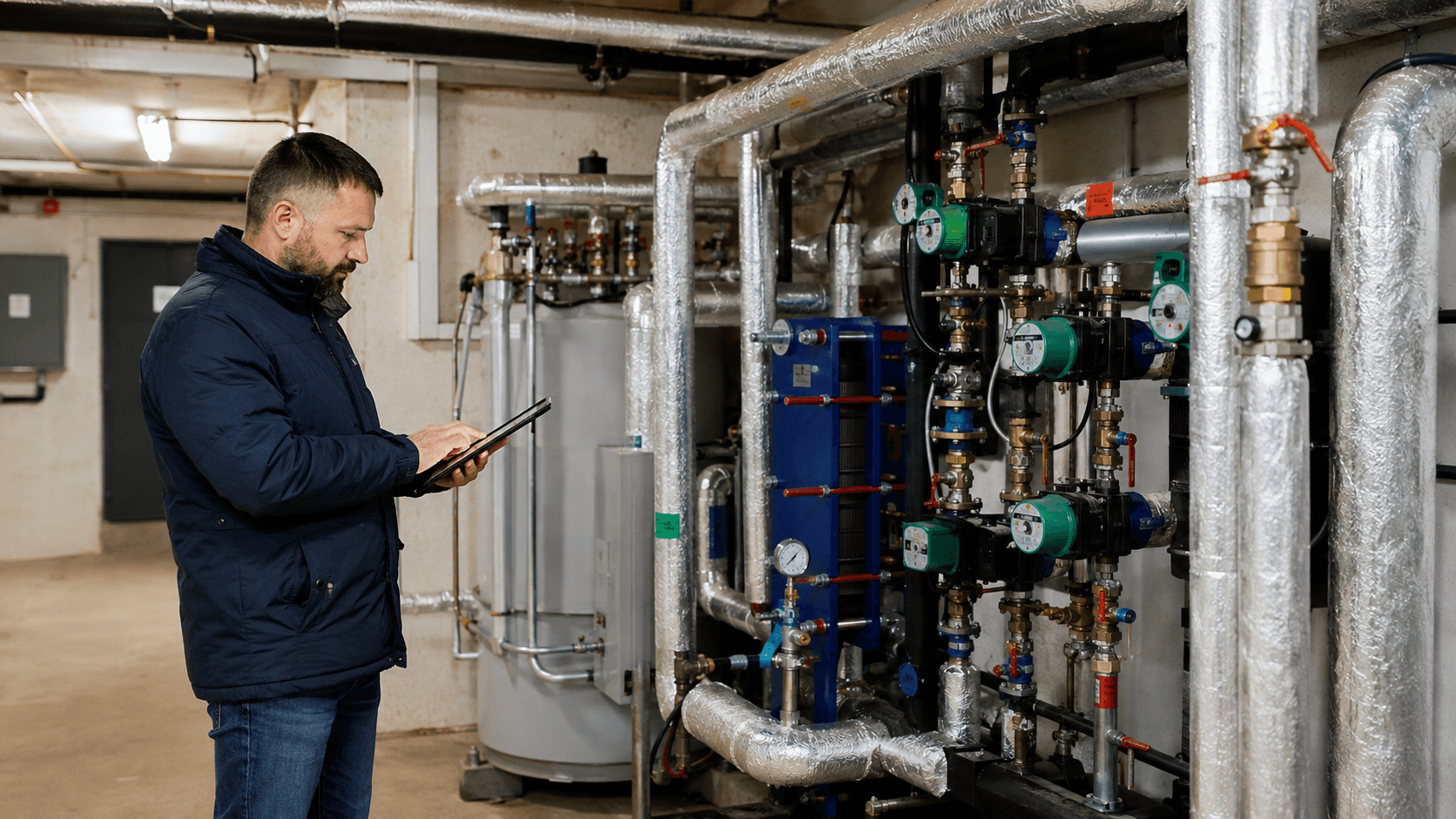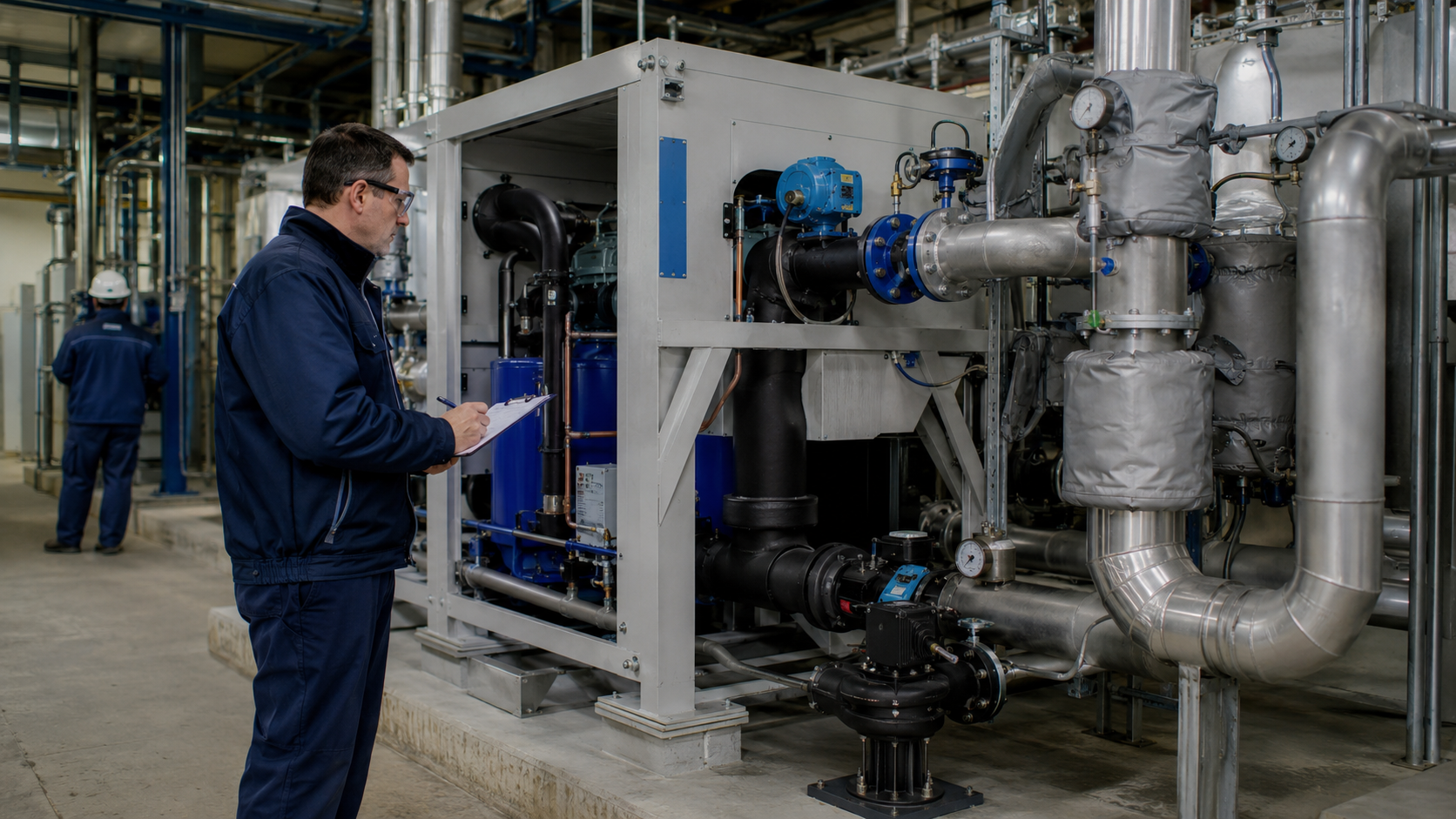
A heat pump can be an excellent solution in an industrial plant, but only when the two sides of the system are well matched: the heat source and the heat sink. The fact that a unit can reach 90, 120 or 160°C does not in itself show whether the investment will be technically and economically justified.
In practice, the first step is to establish where the heat will come from, at what temperature and for how many hours it is available, and then where it needs to go, what temperature the heat sink requires and whether the demand occurs at the same time. Only then does it make sense to select the capacity, technology, refrigerant and specific unit.
The key rule: do not start the analysis of an industrial heat pump with catalogue capacity or a single COP point. Start with the balance of the heat source–heat sink pair and how it operates over time.
When does an industrial heat pump make sense?
The terms “industrial heat pumps” and “heat pumps for industry” cover a very wide range of systems. The best conditions usually occur when a business has a stable heat source at the highest practical temperature and a steady heat sink requiring only a slightly higher temperature. The smaller the temperature lift required from the heat pump, the more favourable its operating conditions will generally be.
Potential sources include heat from refrigeration systems, cooling-water circuits, process water, process effluent, process air or another stream whose temperature and availability have been confirmed. Conventional sources such as outdoor air, ground or water are also possible, but in industrial applications it should not be assumed in advance that they will be the best option.
On the sink side, applications may include process-water heating, domestic hot-water production, space heating for production halls or offices, process-air heating, washing, drying or another heat-consuming process. High-temperature solutions are already available for temperatures above 100°C, but an achievable supply temperature is not the same as good efficiency and economics at a specific operating point. The IEA notes that industrial heat pumps below 120°C are already operating commercially, while solutions below 160°C are beginning to enter commercial operation; higher temperature levels still remain more strongly associated with demonstration and development.
Start with the heat source–heat sink pair
An initial screening should be carried out separately for each potential pair. A large plant may have several sources and several sinks, and the most obvious combination is not always the best one.
| What to check | Heat source | Heat sink | Why it matters |
|---|---|---|---|
| Temperature | inlet and outlet temperature, and its variability | required supply temperature and permissible return temperature | determines the required temperature lift |
| Capacity | instantaneous capacity and minimum available useful capacity | instantaneous and base demand | limits the feasible heat-pump capacity |
| Operating profile | hours, shifts, days of the week, seasonality | the same data for the heat sink | shows the period of simultaneous operation |
| Medium | water, glycol, air, effluent, process medium, etc. | water, air, steam or process medium | affects heat exchangers, fouling, corrosion and safety |
| Location | where the heat is generated | where the heat is used | affects pipe length and losses |
| Infrastructure | ability to connect a heat exchanger and extract heat | ability to accept the new operating parameters | may determine the integration cost |
If the objective is a broader assessment of where waste heat is generated in the plant and how it can be used, start with an analysis of industrial heat recovery. For a heat pump, however, the key question is whether a specific source and sink can be matched efficiently in terms of temperature, capacity and operating time.
Before adding a vapour-compression heat pump to such a pair, it is worth checking the direct heat-recovery option using a heat exchanger. If the source temperature is already sufficient for the sink after allowing for the required heat-exchanger temperature difference, a simpler system may be more advantageous. A heat pump becomes particularly justified when the temperature level needs to be raised or when process requirements make separation of the circuits necessary.
What data should be collected before selecting a heat pump?
1. Temperature and actual capacity of the low-temperature heat source
It is not enough to note that “we have warm water at 35°C”. At a minimum, check:
- the source temperature at the inlet and after the planned cooling;
- the minimum, average and maximum temperature under different production conditions;
- the medium flow rate or another parameter that allows the available capacity to be calculated;
- how long the source is available over the day, week and year;
- the effect of heat extraction on the core process;
- the quality of the medium: contamination, suspended solids, chemical aggressiveness, fouling and freezing risk;
- the distance from the potential heat sink.
If the source is a water stream, its available thermal capacity can initially be estimated from Q = ṁ × cp × ΔT. The result is useful only after confirming that this flow rate and cooling range are actually permissible for a sufficient number of hours.
2. The temperature actually required by the heat sink
This is one of the most frequently overlooked steps. The objective is not to establish the temperature currently produced by the boiler room or central network, but the temperature actually required by the process.
If a central system supplies 110°C only because it was designed that way many years ago, while a specific heat sink requires 75°C, integrating a heat pump at the 75°C level may be far more advantageous than trying to replace the entire 110°C heat source. IEA HPT analyses indicate that integration closer to the process can reduce the required temperature level and improve COP.
It is therefore worth checking:
- the minimum required supply temperature;
- the return temperature;
- the permissible range of temperature variation;
- the required flow rate;
- whether the process requires hot water, air or steam;
- whether some heat sinks can be separated into a lower-temperature circuit.
3. Hourly and seasonal profiles on both sides
Maximum capacity says little about annual operation. Two 1 MW streams do not automatically create a 1 MW project if one occurs at night and the other only during the day.
For this reason, it is best to build a common hourly profile for the source and sink, or at least shift-based and monthly profiles. What matters is the overlap — the period when, simultaneously:
- the source has sufficient temperature and capacity;
- the heat sink actually requires heat;
- the heat pump can operate within its permissible range.
It is this overlapping part of the profile, rather than the sum of the operating hours of each system separately, that determines heat-pump utilisation.
4. Available electrical capacity
The heat supplied to the sink comes partly from the low-temperature heat source and partly from the energy supplied to the system. The share of each depends on COP and on the adopted system boundary, so it should not be assumed that the low-temperature source will always provide most of the energy. For large installations, an additional several hundred kilowatts or several megawatts of electrical demand may require checks of transformers, switchgear, protection devices, cables, contracted capacity and grid connection conditions.
A lack of electrical headroom can be just as significant a constraint as a source temperature that is too low. IEA HPT Annex 58 notes that available grid connection capacity can limit feasible heat-pump capacity and have a major impact on integration costs.
5. Integration cost, not just equipment price
For an industrial heat pump, the unit itself is only one part of the investment. The analysis should also include, among other things:
- heat exchangers on the source and sink sides;
- pipework, circulation pumps and valves;
- buffer tanks or thermal storage, if required;
- the electrical system and any required power-supply upgrade;
- automation and integration with process controls;
- site preparation, foundations and structural works;
- safety solutions and requirements resulting from the refrigerant used;
- downtime costs and connection to the existing installation.
For this reason, the question “how much does a 1 MW industrial heat pump cost?” says little about the cost of the overall project unless the heat source–heat sink configuration is known.
Why does the temperature difference affect COP and operating costs?
A heat pump must raise the temperature from the source level to the level required by the heat sink. The greater this temperature lift, the more compressor work the cycle requires and the lower the COP will generally be. The IEA HPT Annex 58 report explicitly notes that an increasing temperature difference raises electricity demand, while lowering the required temperature on the sink side can improve COP.
For an initial assessment, the difference between source temperature and sink supply temperature can be considered, but a real system also has temperature differences across the heat exchangers. In a conventional subcritical vapour-compression cycle, the refrigerant evaporates at a temperature below the source and condenses at a temperature above the heat-delivery level. In transcritical systems, conventional condensation does not occur on the high-pressure side, but the required heat-exchanger approach temperatures must still be taken into account. In both cases, the actual thermodynamic lift is greater than the simple difference between two temperatures measured in the external circuits.
For example, a source at 40°C and a heat sink requiring 70°C create completely different conditions from a 10°C source and a 120°C sink. Both systems can be described as an “industrial heat pump”, but their electricity consumption and economics will be entirely different.
A simple example of the effect of COP on electricity use
For illustration only, assume that the heat sink requires 1 MW of heat for 4,000 hours per year, giving a total of 4,000 MWh of useful heat.
- at COP = 4: Pₑₗ = 1 MW / 4 = 250 kW, and Eₑₗ = 250 kW × 4000 h = 1000 MWh/year;
- at COP = 2.5: Pₑₗ = 1 MW / 2.5 = 400 kW, and Eₑₗ = 400 kW × 4000 h = 1600 MWh/year.
The difference is 600 MWh of electricity per year for the same amount of useful heat. The relationship Pₑₗ = Q̇ₕₑₐₜ / COP is valid only when the thermal capacity and COP refer to the same system boundary. If the catalogue COP covers only the heat-pump unit, auxiliary equipment such as circulation pumps or fans must be added separately when analysing the complete installation. This is a calculation example, not a forecast for a specific installation.
At the initial stage, the energy cost of producing 1 MWh of heat can be approximated as:
electricity cost per 1 MWh of heat ≈ price of 1 MWh of electricity / COP.
The comparison should then include auxiliary-equipment costs, maintenance, capacity-related charges and the cost of capital, and the result should be compared with the avoided marginal cost of the existing heat source. The electricity price should not be compared with the fuel price alone without accounting for efficiency and the full cost structure.
Where do heat pumps have the greatest potential in industry?
Heat from refrigeration systems
This is one of the most natural applications because a plant may need cooling and heating at the same time. Heat previously rejected to the environment on the condenser side can become a source for a heating process or hot-water system.
First, however, check whether some of the heat can be used directly through a heat exchanger. A heat pump is primarily needed when the temperature of the recovered heat is too low for the heat sink. The broader topic of system optimisation is covered on the refrigeration page.
Systems in which cooling and heating occur simultaneously for a large part of the year are particularly interesting. In such cases, a heat pump can simultaneously provide useful cooling for one process and deliver heat to another sink. This does not automatically mean lower energy consumption on both sides — the result must be calculated for the complete new system and compared with the baseline, taking compressors, pumps, fans and other auxiliary equipment into account.
Process water, cooling water and other stable streams
A good low-temperature heat source is one whose temperature, flow rate and operating time can be determined reliably. In practice, process-water circuits, water after machine and process cooling, process effluent or other liquid streams may all be useful.
The mere presence of warm water is not enough. It must be confirmed whether it can be cooled to the assumed level without affecting the process and whether the heat exchanger can be kept clean in operation.
Process air and drying processes
In some processes, warm exhaust air can be the heat source while air supplied to the process is the heat sink. If direct heat recovery is possible, it should be analysed first. A heat pump becomes justified when a further temperature increase is required and the source profile matches the demand profile.
Heat pumps for businesses, municipalities and large public facilities
Heat pumps for businesses and municipalities should be assessed using the same source–sink logic. This applies, for example, to shopping centres, warehouses, hospitals, swimming pools, sports facilities, wastewater treatment plants, municipal facilities and other large buildings where cooling and demand for hot water, space heating or process heat may occur at the same time. This is not simply the same as selecting a heat pump for a single-family home: the operating profiles of multiple systems, heat-transfer infrastructure, reliability requirements and the way the unit is integrated into the existing system are much more important.
High-temperature heat pumps for process heat
High supply temperatures are technically possible in an increasing number of solutions. However, technology should not be selected solely on the basis of the maximum temperature quoted in a brochure. A process requiring 120°C will look very different with a 70°C heat source than with water at 15°C.
For this reason, before discussing a manufacturer or model, define the complete operating envelope: minimum and maximum source temperatures, sink temperatures, required capacities, control range and the number of hours at the individual operating points.
When does a heat pump look good in the catalogue but the project no longer make sense?
| Situation | Why it can be misleading | What to check |
|---|---|---|
| The unit reaches the required maximum temperature | the maximum temperature does not indicate the COP at that operating point | the performance map for the actual source and sink temperatures |
| There is “a lot of waste heat” in the plant | it may occur at different times from the heat demand | the common source and sink profile |
| The source has high instantaneous capacity | it may operate for only a few hundred hours or vary significantly | annual energy and minimum stable capacity |
| The heat sink has high capacity | it may require a high temperature only during short peaks | base and peak temperature and capacity levels |
| The catalogue COP is high | it often applies to a single test point | COP or power input across the full operating range, including part load |
| The equipment price looks attractive | it may not include heat exchangers, pipework, electrical systems and automation | full integration CAPEX |
| There is plenty of thermal capacity but little electrical capacity | a power-supply upgrade may change the scope and schedule of the investment | grid connection capacity, transformers, switchgear and capacity charges |
Designing solely around the rated point is particularly risky. The IEA HPT report on testing high-temperature heat pumps emphasises that part-load behaviour is application-specific and should be assessed where the installation will actually operate over a variable range.
Part-load operation, peak source and backup
A heat pump does not always need to cover maximum demand. A system in which it serves the base load, while short peaks remain with the existing boiler, another source or an additional unit, is often more advantageous.
Several questions need to be answered during selection:
- what is the heat pump’s minimum stable load;
- whether the unit modulates or will start and stop frequently;
- how COP changes at part load;
- whether several smaller units are more cost-effective than one large unit;
- what happens when the low-temperature source is unavailable;
- which source provides backup during a failure or scheduled service;
- whether a thermal buffer can reduce short-term mismatches between source and sink.
In a production plant, backup is not merely an energy issue. If a lack of heat stops production, reliability criteria may be more important than maximising the heat pump’s annual share.
How should a heat pump be integrated with an existing installation?
The thermodynamically best connection point is not always the easiest to implement. IEA HPT distinguishes between integration closer to the process and integration at the level of central infrastructure. Process-level integration can reduce the required temperature and transmission losses, but it generally increases dependence on a specific production line and project complexity.
In practice, at least three options should be compared:
- connection directly at the heat sink – the lowest possible temperature level, but greater intervention in the process;
- connection to a dedicated process circuit – a compromise between efficiency and flexibility;
- connection to the central heat network – organisationally simpler, but often requiring the highest temperature and increasing the lift.
The analysis must also include transmission losses, pressure drops, circulation-pump power and the possibility of operating existing heat sources in parallel. If the heat source is several hundred metres from the sink, the cost of pipework and infrastructure may determine the outcome before the price of the heat pump itself does.
The heat-transfer system can determine the outcome
With distributed sources and sinks, pipe length alone is not enough. For both the source-side and sink-side circuits, define the medium, supply and return temperatures, flow rate, pressure drops, pump power, insulation, heat losses and the method of hydraulic separation. The actual installation routes also matter: passages through production halls, internal roads, fire zones or areas where production shutdown is required.
If transmission losses lower the source temperature or force a higher parameter on the sink side, the required lift increases and heat-pump operating conditions deteriorate. This is why the heat-transfer system for the heat pump is part of the technical balance and CAPEX, not an add-on selected after the unit itself.
Do photovoltaics or cogeneration improve heat-pump economics?
They can, but they do not fix a poorly matched source–sink pair.
Photovoltaics can reduce the cost of part of the electricity consumed by the heat pump if PV generation and heat-pump operation occur during the same hours, or if the system has another way of using the electricity. In plants with year-round heat demand, the profile may be more favourable than in typical seasonal heating, but it still needs to be calculated using hourly data.
Cogeneration can remain part of the existing system and act as a parallel, peak or backup source. However, it should not be assumed that powering the heat pump with electricity from cogeneration automatically improves overall system efficiency. A fuel, electricity and heat balance is required for the specific option.
If a company is considering a heat pump as one of several possible heat-generation technologies, it should also be compared with other options for modernising the heat source. For the heat pump itself, however, a technical assessment of its operating conditions at the specific site remains essential.
What determines the price of an industrial heat pump and the economics of the investment?
At concept stage, four quantities are more useful than the price of the heat-pump unit itself:
- annual useful heat delivered by the heat pump in practice;
- annual electricity consumption across the full operating profile;
- avoided operating cost of the existing heat source;
- full integration cost, including electrical, hydraulic and automation systems.
In Heat Pump Monitor 2026, the IEA notes that heat-pump operating costs depend strongly on the relationship between electricity and fuel prices, while industrial deployment faces additional barriers from process-specific integration and high capital expenditure. The calculations should therefore be performed for several energy-price scenarios and different capacity-utilisation levels.
If, for example, a heat pump is expected to operate for only 800–1,200 hours per year, a high COP may not be enough to justify extensive infrastructure. On the other hand, stable operation for several thousand hours, a small lift and a simultaneous need for cooling can significantly improve the project balance.
How to assess heat-pump application feasibility – 8 steps
Step 1. List the heat sources
Record the medium, temperatures, flow rates or capacity, operating hours, location and process constraints. Do not reject a source simply because its temperature is low, but do not assume that every heat loss is useful either.
Step 2. List the heat sinks
For each heat sink, determine the actual required temperature, base and peak capacity, operating hours and the potential to reduce supply temperature.
Step 3. Match sources and sinks
Look for pairs with a strong time overlap, short distance and the smallest practical temperature difference. At this stage, ideas that looked attractive only on the basis of an annual energy balance are often eliminated.
Step 4. Build a common operating profile
An hourly balance is best. Where data are unavailable, start with measurements or reliable data from automation systems, meters and production systems.
Step 5. Define the required temperature range
Do not use only one design temperature. Define minimum, maximum and typical operating points on both sides and check how COP and available unit capacity change.
Step 6. Define the peak and backup source configuration
Decide whether the heat pump should cover the base load, most of the demand or the entire range. Account for failures, servicing, start-ups and production shutdowns.
Step 7. Check the infrastructure
Verify electrical capacity, pipe routes, heat exchangers, available space, automation, environmental conditions, noise, safety and whether the connection can be made without unacceptable downtime.
At this stage, the requirements associated with the refrigerant used must also be checked. Regulation (EU) 2024/573 introduces restrictions concerning fluorinated greenhouse gases and refrigeration/heat-pump equipment, with the scope and deadlines depending on equipment type, capacity, GWP (global warming potential) and safety requirements. The refrigerant selection and equipment compliance must therefore be confirmed for the specific configuration rather than based on a general assumption.
Step 8. Only then select the equipment and calculate the economics
A request for quotation should specify not only capacity and supply temperature, but the complete operating envelope. Require data on power input, COP and thermal capacity at representative points, together with the part-load operating range. Then perform an annual analysis rather than multiplying a single COP by the number of hours.
Industrial heat-pump manufacturer – what should be required in a quotation?
Manufacturer selection should not be the first step. Only once the operating envelope has been defined can units be compared under the same conditions. At a minimum, a request for quotation should require: thermal capacity, power input and COP at several representative source–sink points; minimum stable load and control method; permissible flow rates and temperatures; refrigerant used; electrical requirements; noise data where relevant; control logic; service conditions; and the scope of FAT/SAT acceptance tests (factory and on-site), if planned.
Such a specification allows different industrial heat-pump manufacturers to be compared without basing the decision on a single catalogue COP or maximum supply temperature.
Auditor’s comment: reduce the required temperature first, then select the heat pump
In industrial analyses, the greatest benefit often comes not from searching for a unit with an ever-higher maximum temperature, but from checking whether the heat sink really requires the current temperature level. If part of the process can be separated from a central 110°C circuit and supplied at a lower parameter, for example, the heat pump may operate under far more favourable conditions.
The same applies on the source side: the most valuable source may not be the largest one in energy terms, but the one with a higher temperature, stable profile and short distance to the heat sink. Screening should therefore cover several source–sink pairs, not just one investment concept selected in advance.
Frequently asked questions
What temperature can an industrial heat pump reach?
It depends on the technology and refrigerant. Industrial systems below 120°C are already in commercial operation, while solutions for temperatures below 160°C are beginning to enter commercial applications. Maximum temperature alone is not enough to assess a project — COP, capacity and operating range are needed for the actual source and sink temperatures.
Can heat from refrigeration be used as a heat-pump source?
Often yes, particularly when the refrigeration system operates at the same time as the heat sink. First check the temperature and capacity of the available heat and the potential for direct recovery. A heat pump makes sense when a further temperature increase is required.
Does a high catalogue COP mean the investment will be profitable?
No. COP applies to specific operating conditions. The annual result depends on variable temperatures, part-load operation, operating hours, auxiliary-equipment consumption, energy prices and the cost of the complete integration.
Does an industrial heat pump need a peak heat source?
Not always, but in many plants a hybrid system is more rational than sizing the heat pump for a short-duration maximum. The existing boiler or another source can cover peaks, failures and periods when the low-temperature source is unavailable.
How much electrical capacity does a 1 MW heat pump require?
It depends on the COP at the operating point and on how the system boundary is defined. For 1 MW of useful heat at COP = 4, the simplified electrical input included in the COP definition is approximately 250 kW, and at COP = 2.5 it is approximately 400 kW. If the manufacturer’s COP does not include external circulation pumps, fans or other auxiliary equipment, their consumption must be added separately and the full annual operating profile checked.
Conclusions
An industrial heat pump makes sense when the heat source and heat sink are well matched in temperature, capacity and operating time, and the cost of infrastructure does not cancel out the energy benefits. The key parameter is not the maximum catalogue temperature but the actual temperature lift and annual operating profile.
For this reason, before selecting a manufacturer and unit, carry out a technical screening: inventory the sources and sinks, build operating profiles, check temperatures, part-load operation, electrical capacity, backup and connection costs. Only then can the options be compared reliably and the economics calculated.
If you want to verify a specific source–sink pair in an industrial plant or large facility, contact Energy Trend. The starting point should be an analysis of data and integration options, not an assumption that a heat pump must be used.
Sources and technical materials
- International Energy Agency, Heat Pump Monitor 2026 – Key findings, 2026.
- IEA Heat Pumping Technologies TCP, Annex 58, High-Temperature Heat Pumps – Task 3: Applications and Transition, 2024.
- IEA Heat Pumping Technologies TCP, Annex 58, Task 4: Definition and testing of HP specifications, 2024.
- Regulation (EU) 2024/573 of the European Parliament and of the Council of 7 February 2024 on fluorinated greenhouse gases.